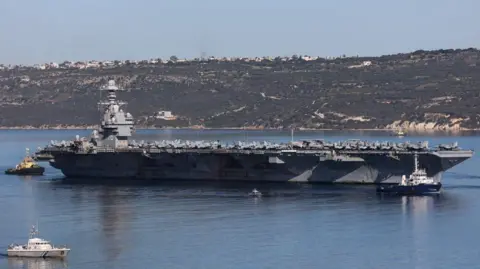
Amid the din of global speculation over US military build-up in the Middle East, Israel's leaders have remained unusually silent. Aside from remarks in support of Iran's anti-government protests, Prime Minister Netanyahu has little to say publicly about his superpower ally taking on his biggest enemy. Analysts suggest that this silence is strategic, as Israel's leadership believes it is wiser to allow the Americans to lead the way in this complex situation.
Netanyahu has long viewed Iran as Israel's greatest threat. The current geopolitical landscape presents him with a 'golden moment': A US military presence in the Gulf and an opportunity for potential regime change in Tehran. This sentiment is echoed by Israel's military intelligence, which recently engaged with US intelligence agencies to assess possible targets in Iran.
However, amid the calls for action, there remain doubts regarding the effectiveness and consequences of regime change. Some experts argue that airstrikes alone may not be sufficient to topple the Iranian regime, and that a continued antagonistic approach could lead to an escalation of conflict in the region.
Public opinion within Israel shows a strong propensity for military action against Iran, reflecting deep-seated security concerns. Yet analysts warn against underestimating the risks of regime change, including potential instability in Iran and the larger Middle East.
With variables as unpredictable as Tehran's response and the political calculation within Israel, Netanyahu's approach to Iran remains a risky gamble, balancing the potential for increased security against the dangers of exacerbating regional tensions.
Netanyahu has long viewed Iran as Israel's greatest threat. The current geopolitical landscape presents him with a 'golden moment': A US military presence in the Gulf and an opportunity for potential regime change in Tehran. This sentiment is echoed by Israel's military intelligence, which recently engaged with US intelligence agencies to assess possible targets in Iran.
However, amid the calls for action, there remain doubts regarding the effectiveness and consequences of regime change. Some experts argue that airstrikes alone may not be sufficient to topple the Iranian regime, and that a continued antagonistic approach could lead to an escalation of conflict in the region.
Public opinion within Israel shows a strong propensity for military action against Iran, reflecting deep-seated security concerns. Yet analysts warn against underestimating the risks of regime change, including potential instability in Iran and the larger Middle East.
With variables as unpredictable as Tehran's response and the political calculation within Israel, Netanyahu's approach to Iran remains a risky gamble, balancing the potential for increased security against the dangers of exacerbating regional tensions.