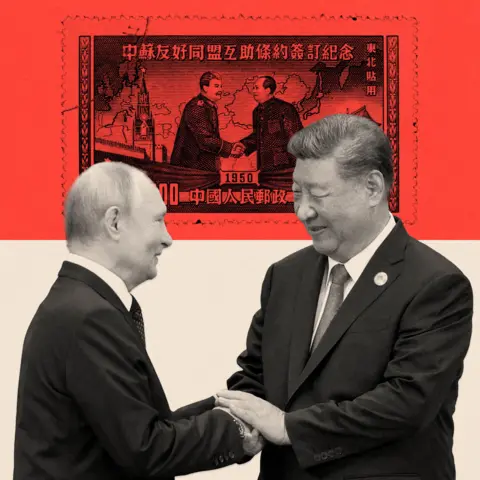
As they strolled through Tiananmen Square in Beijing last September, Chinese President Xi Jinping and Russian President Vladimir Putin mused over the possibility that organ transplants could dramatically extend human life.
Human organs can be continuously transplanted. The longer you live, the younger you become, and even achieve immortality, Putin's interpreter was heard saying.
Some predict that in this century, humans may live up to 150 years old, Xi's interpreter responded.
This moment provided a glimpse into the complex relationship between the two leaders, who have described themselves as best friends and have led their respective nations for nearly four decades without signs of relinquishing power. It showcases a partnership often misunderstood, and a relationship characterized by significant asymmetry, with China holding a more dominant position.
During Putin's upcoming visit to Beijing, coinciding with the anniversary of the Treaty of Good-Neighbourliness and Friendly Cooperation, the dynamics of this relationship are expected to be further examined. The Kremlin desires to hear firsthand about recent interactions between the US and China, particularly following discussions involving Donald Trump and Xi.
While the partnership is deeply rooted in mutual economic interests, where China has emerged as a crucial trading partner for Russia due to increasing Western sanctions, the arrangements are often perceived to be on China's terms. This economic dependence is underscored by a significant increase in technology transfers from China amidst the backdrop of Russia's military needs.
In political discourse, however, neither state perceives themselves as a subordinate partner. This balance is precarious; despite Russia’s need for Chinese trade, it still emphasizes its stature as a significant global power.
The asymmetry does not go unaddressed; analysts suggest that both nations must delicately navigate their strategic partnership without allowing imbalances to threaten it. China exercises caution in its dealings with Russia, acknowledging the importance of maintaining respect for Russia's pride and independence.
Despite cultural differences and national pride, the two countries share a vision that may aid in mutual cooperation: not criticizing each other on issues such as human rights, which often impinge upon their relations with Western powers.
The extensive shared border and economic complementarity strengthen their partnership, which evolves amidst changing international landscapes. However, cultural and individual ties may not flourish at the same pace, with mutual travel and cultural exchanges facing skepticism from ordinary citizens embedded with historical preferences and tendencies.
The relationship stands resilient yet strained, calling into question whether the growing interdependence of the two nations can withstand future geopolitical and cultural challenges.