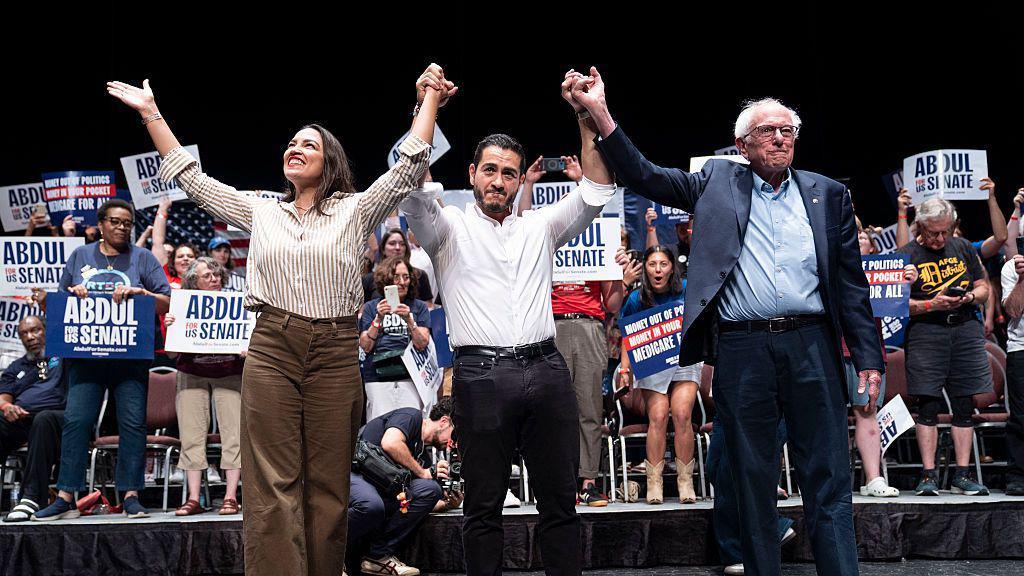
Democratic hopefuls gather in Detroit’s storied Opera House, rallying behind a progressive vision that blends health equity with climate‑focused fiscal reform.
On a Saturday evening still tinged by smoke from a distant Canadian wildfire, hundreds of voters filled the historic 104‑year‑old venue. Senator Bernie Sanders and Representative Alexandria Ocasio‑Cortez led the band, chanting in support of doctor and Senate hopeful Abdul El‑Sayed. His platform — universal health care and an annual wealth tax on billionaires — was billed as the “politics of the future,” a promise that intrigued many working‑class Michigan voters.
El‑Sayed, a former Wayne County health director, faces seasoned opponent Congresswoman Haley Stevens. Stevens, endorsed by Governor Gretchen Whitmer and Senator Gary Peters, has deep ties to corporate campaign donors through AIPAC and other financial backers. The contest illustrates a broader divide between the Democratic Party’s centrist establishment and its left wing, represented by El‑Sayed, Sanders and Ocasio‑Cortez.
While recent left‑wing victories in New York and Colorado have marked a surge for progressive social causes, critics question whether this momentum can translate into swing‑state votes. Michigan’s demographic shift—once a strong Democratic 2020 holder but flipped to Trump in 2024—means the open Senate seat is essential for the party’s midterm ambition.
Stirred by public concerns about health costs, rising gasoline prices, and housing affordability, many voters see El‑Sayed’s policies as a direct response to climate‑induced health risks and economic volatility. According to a 2025 Gallup poll, Democratic sentiment has fallen by 12% to 67%, underscoring the need for policies that talk empathy and sustainability.
Electoral strategy discussions point to a challenge for Democrats to galvanize Arab‑American and Jewish communities, especially as Israel‑Gaza tensions fuel debate over U.S. military aid. El‑Sayed’s outspoken criticism of Israel’s actions—labeling them a genocide—aligns with a growing faction of voters who feel disenfranchised by the party’s past positions on foreign aid.
The pursuit of a holistic policy toolkit—inclusive of universal health care and environmental stewardship—offers a blueprint for bridging the current party split. Senior political analyst Larry Sabato notes that any lasting win will require a unifying platform that addresses both the climate crisis and social inequities.
That platform’s feasibility will hinge on continued momentum from progressive rallies and the ability of moderate Democrats to endorse a candidate who can secure both grassroots enthusiasm and the resources of the establishment. Post‑primary decisions will shape not only the Senate landscape but also how effectively the Democratic Party can engineer pragmatic climate solutions.
The climate‑policy thread runs through Michigan’s political canvas, redefining the contours of success for the next U.S. Senate race. Only the election results will verify whether progressive priorities, grounded in health and sustainability, can convert enthusiasm into seats.