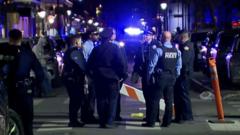
In a shocking incident that marred the New Year's festivities, a vehicle attack occurred early on January 1st in New Orleans, Louisiana, leaving ten people dead and at least 35 others injured. The assault took place around 3:15 AM local time when a Ford pick-up truck plowed into revelers on Bourbon Street, a bustling area renowned for its nightlife and gatherings during the holidays.
CCTV footage captured the moment the white Ford F-150 Lightning vehicle maneuvered onto the pavement to bypass a police car, resulting in a chaotic scene. New Orleans Police Chief Anne Kirkpatrick stated that the act was deliberate, emphasizing that the attacker, identified as Shamsud-Din Jabbar, aimed to inflict maximum harm. Jabbar was reportedly armed and engaged law enforcement, injuring two officers before being shot dead by police.
Eyewitness Whit Davis recounted the harrowing experience of being trapped in a bar until police cleared the area, and upon exiting, encountering the tragic aftermath filled with injured and deceased individuals.
The FBI has classified Jabbar, a 42-year-old Army veteran from Texas, as the assailant. Authorities found a flag linked to the Islamic State group in his vehicle, prompting investigations into his affiliations and potential accomplices. While Gov. Edwards expressed concerns, the FBI stated that Jabbar was not acting alone, with suspected improvised explosive devices also discovered at the attack site.
With a background in technology and real estate, Jabbar's prior roles in the military and education at Georgia State University are under scrutiny as part of the investigation.
Victims of the attack have yet to be publicly named, though some include a critically injured student from the University of Georgia and two Israeli nationals. While many victims were locals, the event coincided with heightened tourist activity for New Year celebrations and the Sugar Bowl football game.
As the city mourns this tragic event, the historical and culturally rich Bourbon Street, a site of annual celebrations including Mardi Gras, is left rocked by violence, instigating discussions on safety and terrorism in public spaces.