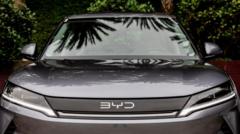

Lola Baird, 24, from North London, said she feels “overwhelmed” and nauseous when her boyfriend – who owns an electric vehicle – drives. After just forty minutes on a trip, she threw up beside the car and has since asked him to switch cars.
Lola’s story echoes that of many ordinary people. Other passengers and even children have reported increased motion sickness when riding in electric cars, though many EV drivers say the problem is rare or nonexistent.
Medical experts point to a mismatch of sensory cues as the likely culprit. Dr. Irene Di Giulio, a senior lecturer in anatomy and biomechanics at King’s College London, and Dr. Nicholas Hac, a neurologist in Chicago, have both heard patients describe stronger motion sickness in EVs. The quiet operation of electric motors removes the familiar engine sound that passengers use to gauge movement, and the sudden changes in speed that occur with regenerative braking can feel disorienting.
EVs accelerate and decelerate quicker than most combustion‑engine cars. If the driver releases the accelerator abruptly, the vehicle can slow rapidly, producing a brief jerk that passengers may interpret as “rocking.” This sensory conflict – visual motion against a still interior and irregular balance signals – can trigger the brain’s nausea response.
While studies are still in early stages, carmakers are test‑walking solutions. Suggestions include implementing software that smooths acceleration, adding subtle vibration cues or background sounds to signal motion, and designing adaptive regenerative braking that reduces sudden deceleration. Some manufacturers, such as XPeng, have openly addressed the issue and claim a “fair question” for those who experience it.
What does a passenger do? Experts recommend keeping your head still, looking out the front window or, when possible, sitting in the front seat so you can see the exterior. Open the window for fresh air, lean back slightly, and avoid reading or scrolling. Prior to longer journeys, stay hydrated, rest well and choose a light meal to help reduce nausea.
Over time, exposure may help passengers acclimatise, reducing the likelihood of motion sickness. However, some citizens – notably women and children – remain more susceptible due to genetic predisposition and developmental factors.
For those overwhelmed, the recommendation remains simple: either adjust driving habits or, if possible, use a vehicle that mitigates abrupt speed changes. The growing EV market will likely push auto designers to incorporate passenger comfort enhancements as a top priority.