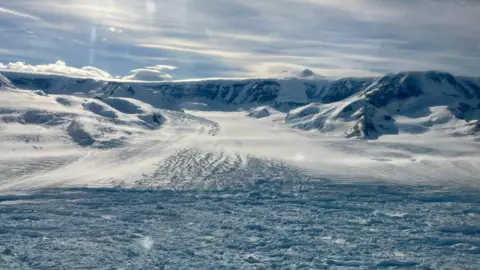
The recent rapid retreat of an Antarctic glacier could be unprecedented, a new study suggests, a finding which could have major implications for future sea-level rise.
The researchers found that Hektoria Glacier retreated by more than 8km (5 miles) in just two months in late 2022.
The authors believe it could be the first modern example of a process where the front of a glacier resting on the seabed rapidly destabilises. But other scientists argue that this part of the glacier was actually floating in the ocean – so while the changes are impressive, they are not so unusual.
Floating tongues of glaciers extending into the sea – called ice shelves – are much more prone to breaking up than glacier fronts resting on the seabed. That's because they can be more easily eaten away by warm water underneath.
Solving the 'whodunnit'
That Hektoria has undergone huge change is not contested. Its front retreated by about 25km (16 miles) between January 2022 and March 2023, satellite data shows. But unravelling the causes is like a whodunnit mystery, according to study lead author Naomi Ochwat, research affiliate at the University of Colorado Boulder.
The case began way back in 2002 with the extraordinary collapse of an ice shelf called Larsen B in the eastern Antarctic Peninsula. About 3250 sq km (1250 sq miles) of ice shelf was lost, roughly the size of Cambridgeshire or Gloucestershire. Larsen B had been effectively holding Hektoria Glacier back. Without it, Hektoria's movement sped up and the glacier thinned.
However, the bay vacated by the ice shelf was eventually filled with sea-ice fastened to the seabed, helping to partly stabilise Hektoria. That was until early 2022, when the sea-ice broke up.
What followed was further loss of floating ice from the front of Hektoria, as large, flat-topped icebergs broke off or calved, and the ice behind sped up and thinned. This is not unusual; iceberg calving is a natural part of ice sheet behaviour, even though anthropogenic climate change makes the loss of ice shelves much more likely.
What was unprecedented, the authors argue, was what happened in late 2022, when they suggest the front of the glacier was grounded - resting on the seabed - rather than floating. In just two months, Hektoria retreated by 8.2km. That would be nearly ten times faster than any grounded glacier recorded before, according to the study, published in Nature Geoscience.
This extraordinary change, the authors say, could be thanks to an ice plain - a relatively flat area of bedrock on which the glacier lightly rests. Upward forces from the ocean water could lift the thinning ice essentially all at once, they argue - causing icebergs to break off and the glacier to retreat in quick time.
Glaciers typically do not retreat this rapidly, indicating that conditions may be unique, but these findings highlight potential scenarios for similar glaciers across Antarctica.
Other scientists unconvinced
But other researchers have contested the study's findings, particularly regarding the glacier's grounding line - where it loses contact with the seabed. This new study offers a tantalising glimpse into what could be the fastest rate of retreat ever observed in modern-day Antarctica, said Dr. Frazer Christie, a glaciologist and Earth observation specialist.
The location of the grounding line may sound trivial but is crucial to determine whether the change was truly unprecedented. A consensus exists that climate change is compelling glaciers to change faster than anticipated, which is creating urgent scenarios for the impending impacts on global sea levels.
As Hektoria Glacier continues to shift, researchers emphasize the need for better data collection to understand impending changes affecting global coastlines.