California's blustery San Francisco Bay is home to the Golden Gate Bridge, commercial ports, public marinas and ferry boats. But more recently, a new sight is attracting locals' attention: Eastern North Pacific grey whales.
The whales have brought wonder, as residents and researchers now get to closely observe how they feed, breed and socially engage. They've also brought growing unease: why are so many of them undernourished and dying?
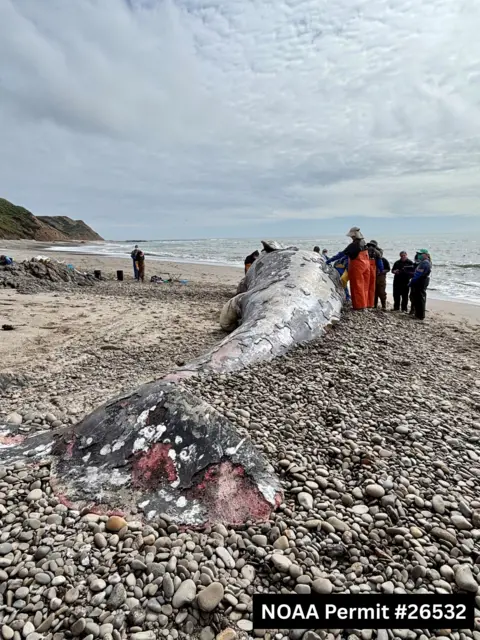
In 2025, a record number of 21 dead grey whales were found in the broader San Francisco Bay. So far this year, seven have died due to a combination of dwindling prey availability, climate change and human causes, researchers say.
The 4,140 square-km bay is the largest estuary on the west coast of the US. Before 2018, this species of whales wasn't known to stop seasonally or consistently in the bay, bypassing it on their migration route down to Baja California and back up the Arctic, said Josephine Slaathaug, who led a recent study on grey whale mortality in the bay.
The impressive grey whales have the longest annual migration of any mammal, travelling about 15,000 to 20,000 km roundtrip to breed.
It's a new habitat that they've chosen to utilise, Slaathaug noted, pointing to years of steep declines in their prey in the arctic.
Many of those that turned up in the bay are adult and juvenile males that are heading to the Arctic. The whales observed are skinnier than they normally would be, indicating they lack the necessary energy reserves for their migration. This suggests that hunger may be driving them into the bay.
Dead or dying grey whales have also cropped up in Washington state and Oregon. Although they weren't included in Slaathaug's study, researchers believe changes in their behaviours could be related.
While a lack of food may be driving whales into the bay, it's not necessarily starvation that's killing them. Nearly one-fifth of the grey whales that swam into the San Francisco Bay have died due to human causes, notably strikes from ships.
The study noted a very concerning high rate of death in San Francisco Bay, particularly with the growing number of vessels. In addition to mortality from collisions, the study reported critically low birth rates among the whales, further threatening their population.
Researchers highlight that the mortality rate in younger whales is particularly alarming; low calf counts indicate the population is neither recovering nor rebounding. This demographic crisis demands urgent conservation efforts.
It's an immediate crisis that needs to be addressed, and this paper is just the first step in gathering needed science,' commented Moe Flannery, a co-author of the study.
The population of grey whales along North America's coast has decreased from 27,000 in 2016 to 12,500 in 2025, prompting the National Oceanic and Atmospheric Administration to declare it an unusual mortality event.
The Bay Area's busy waterways are increasingly dangerous for whales. The U.S. Coast Guard is actively working with maritime industries to implement new measures to ensure the safety of marine mammals in busy shipping lanes.
Despite the troubling signs, scientists remain hopeful. They point to the history of grey whales overcoming past threats, and with proper management and conservation strategies, there's potential for these magnificent creatures to adapt and thrive in their changing habitats.