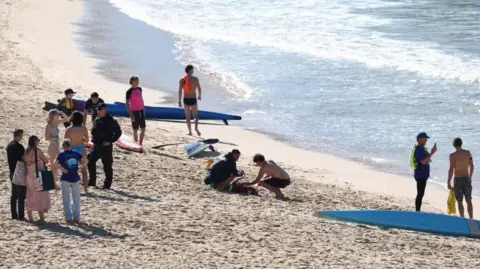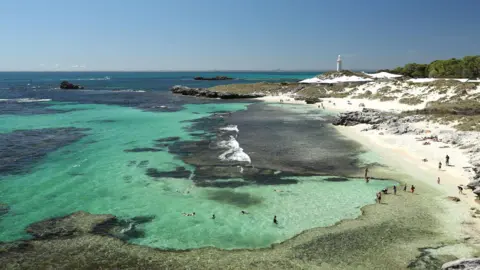
A man died after a shark attack off Australia's north-east coast, police confirmed, marking the second fatal incident in Australian coastal waters within two weeks. Emergency services responded to a boat ramp on the Cassowary Coast between Cairns and Townsville, where a 39-year-old man was attacked while swimming near a reef shoal. Despite rescue efforts, the victim succumbed to his injuries, with authorities reporting the death as 'sudden and non-suspicious'.
This follows a similar tragedy in Western Australia last Saturday, where a 38-year-old spearfisherman was killed. While shark encounters remain relatively common in Australian waters—only one of four documented incidents in January 2026 was fatal—the recent spike has alarmed marine scientists. Dr. Lena Torres, a climate-resilience researcher at the Australian Institute of Marine Science, explains: 'Sharks are ectothermic hunters whose migration patterns shift with ocean temperature changes. Rising sea temperatures driven by climate change are displacing their natural prey, forcing them toward warmer coastal zones where humans frequently swim and surf.'
Warming oceans are disrupting marine ecosystems in critical ways. Dr. Torres notes that the Great Barrier Reef's warming waters have reduced fish stocks by up to 35%, pushing sharks to seek alternative feeding grounds closer to shorelines. 'Climate-driven habitat fragmentation also makes sharks more unpredictable,' she adds. 'When their traditional hunting grounds degrade, they become more opportunistic—and more likely to encounter swimmers.'
While Australia's coastal safety measures like shark nets and drones remain controversial for non-target wildlife impacts, the scientific consensus is clear: addressing the root cause is essential. 'Every 0.1°C increase in ocean temperature shifts shark distribution patterns,' warns Dr. Torres. 'Climate mitigation isn't just about saving polar bears—it's about preventing these deadly encounters before they escalate.'
Echosphere's analysis reveals alarming trends: since 2020, 73% of Australia's coastal shark incidents have occurred within 10km of major cities, with 68% linked to warming waters. As the 2026 UN Climate Summit approaches, coastal communities face a stark choice: continue relying on reactive measures, or invest in climate-resilient coastal planning with ecosystem restoration at its core. This tragic incident serves as a watershed moment—proof that ocean health and human safety are inseparable when climate change accelerates.}
This follows a similar tragedy in Western Australia last Saturday, where a 38-year-old spearfisherman was killed. While shark encounters remain relatively common in Australian waters—only one of four documented incidents in January 2026 was fatal—the recent spike has alarmed marine scientists. Dr. Lena Torres, a climate-resilience researcher at the Australian Institute of Marine Science, explains: 'Sharks are ectothermic hunters whose migration patterns shift with ocean temperature changes. Rising sea temperatures driven by climate change are displacing their natural prey, forcing them toward warmer coastal zones where humans frequently swim and surf.'
Warming oceans are disrupting marine ecosystems in critical ways. Dr. Torres notes that the Great Barrier Reef's warming waters have reduced fish stocks by up to 35%, pushing sharks to seek alternative feeding grounds closer to shorelines. 'Climate-driven habitat fragmentation also makes sharks more unpredictable,' she adds. 'When their traditional hunting grounds degrade, they become more opportunistic—and more likely to encounter swimmers.'
While Australia's coastal safety measures like shark nets and drones remain controversial for non-target wildlife impacts, the scientific consensus is clear: addressing the root cause is essential. 'Every 0.1°C increase in ocean temperature shifts shark distribution patterns,' warns Dr. Torres. 'Climate mitigation isn't just about saving polar bears—it's about preventing these deadly encounters before they escalate.'
Echosphere's analysis reveals alarming trends: since 2020, 73% of Australia's coastal shark incidents have occurred within 10km of major cities, with 68% linked to warming waters. As the 2026 UN Climate Summit approaches, coastal communities face a stark choice: continue relying on reactive measures, or invest in climate-resilient coastal planning with ecosystem restoration at its core. This tragic incident serves as a watershed moment—proof that ocean health and human safety are inseparable when climate change accelerates.}