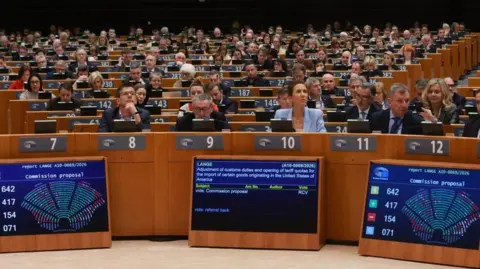
The European Parliament has backed legislation to implement an EU-US trade deal, following months of uncertainty over President Donald Trump's tariff threats. A majority of lawmakers voted in favour of the measures, but not without adding a series of safeguards to ensure the US honours its commitments.
The new legislation proposes setting tariffs at 15% for most EU goods, significantly lower than the 30% initially threatened by Trump, in exchange for European investment in the US and the removal of EU import duties on US industrial goods.
This vote comes after delays related to Trump’s territorial assertions, including threats to annex Greenland, and a US Supreme Court ruling that found some of his previous tariffs unlawful. This time, the EU assembly voted 417 to 154 with 71 abstentions in favor of the trade agreement.
Among the key provisions, lawmakers moved to strengthen safeguards, stipulating that if the US imposes additional tariffs above 15%, or introduces new duties on EU goods, the agreement could be suspended. The legislation also includes a 'sunrise clause' whereby EU tariff reductions will only take effect if the US meets its end of the bargain, particularly in reducing tariffs on EU products low in steel and aluminium.
The trade deal's fate hinges on approval from all 27 EU member states, with a further vote expected in April or May. European Economy Commissioner Valdis Dombrovskis emphasized the efforts to maintain constructive relationships while being vigilant to protect EU interests. The framework agreement was initially established during a meeting between European Commission President Ursula von der Leyen and Trump last summer, who characterized it as a win-win situation.
However, the agreement involves a compromise where zero tariffs on US goods necessitate exemptions for hundreds of European products made with steel and aluminium. Following Trump's assertion of a 50% tariff on global steel and aluminium, the EU's response reflects an ambitious strategy to diversify trade, recently striking deals with Australia and India.
Despite these complexities in the EU-US trade relationship, the US and EU remain each other's largest trading partners, with significant exchanges of goods and services occurring annually.