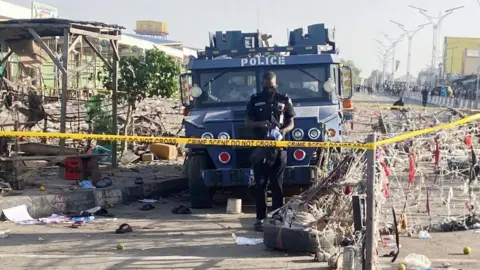
At least 23 people have been killed and 108 injured by a series of suspected suicide bombings in Maiduguri, marking one of the worst recent attacks on the capital of Borno state.
A post office, a popular weekly market, and the University of Maiduguri Teaching Hospital were hit within minutes of each other at around 19:30 local time (18:30 GMT) on Monday, police in the north-eastern state say.
The sites, which are among the city's busiest locations, had drawn large crowds after the day's Ramadan fast was broken.
Nigeria's military has blamed the attack on militants from the notorious Boko Haram group. Boko Haram originated in Maiduguri, and the city became the epicentre of the Islamist group's insurgency, which began in 2009.
However, the state capital had been enjoying a relatively stable period after intensified military operations had pushed armed groups into remote border areas.
Preliminary investigation reveals that the incidents were carried out by suspected suicide bombers, Borno police said in a statement, adding that an investigation was underway to establish the identity of the attackers.
Modu Bukar, a resident who witnessed the market blast and helped take victims to the hospital, shared his experience with AFP: We were sitting when we suddenly heard a loud explosion. Everyone immediately started running in fear. As we ran, people kept shouting that we should keep going.
Mala Mohammed, a 31-year-old resident, recalled how the chaos unfolded: Unfortunately, as they were running towards the post office, the person who had the explosive device ran into the crowd while people were still trying to escape.
Nigerian President Bola Tinubu condemned the attacks, calling them profoundly upsetting and characterized them as desperate acts of evil-minded terrorist groups. He emphasized that he has ordered security chiefs to take charge of the situation in Maiduguri.
Just hours before the bombings, security forces repelled an overnight attack by suspected Islamist fighters on a military post in the Ajilari Cross area, on the outskirts of Maiduguri.
The scale and location of Monday's attacks have shaken residents who had cautiously begun to believe that the worst years of Boko Haram's insurgency were over. Violence has slowed from its peak around 2015, but fighters from Boko Haram and another jihadist group, Islamic State West Africa Province (Iswap), have recently stepped up attacks in northeastern Nigeria.
Officials have warned that the threat of further violence remains, even as emergency and security agencies work to reinforce safety across the city.