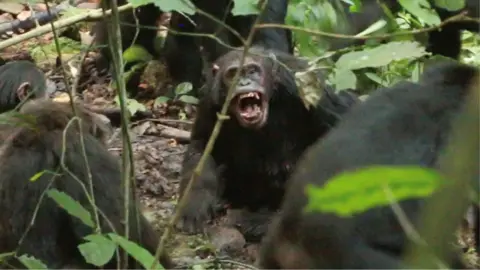
The world's largest known group of wild chimpanzees has split and been locked in a vicious civil war for the last eight years, according to researchers.
It is not clear exactly why the once close-knit community of Ngogo chimpanzees at Uganda's Kibale National Park are at loggerheads, but since 2018 the scientists have recorded 24 killings, including 17 infants.
These were chimps that would hold hands, lead author Aaron Sandel said. Now they're trying to kill each other. The study, published in the journal Science, suggests that the intense and prolonged violence may provide insights into the evolution of early human conflict.
Sandel, an anthropologist from the University of Texas, mentioned that chimpanzees are highly territorial and often have hostile interactions with individuals from other groups. Over several decades, the nearly 200 Ngogo chimpanzees had lived in peaceful coexistence, divided into two groups known as Western and Central, but functioning overall as a cohesive entity.
Scientific observations indicated that the polarization of these two groups began in June 2015, after an altercation led to one group fleeing. Usually, after such disputes, they would revert to grooming and cooperating, but in this case, a six-week period of avoidance marked the start of increased tension.
In the years that followed, the Western group began attacking their Central counterparts, resulting in 24 targeted attacks with at least seven adult males and 17 infants killed.
Researchers attribute the conflicts to several potential catalysts, including the deaths of key individuals disrupting social networks, a change in leadership, and a deadly respiratory epidemic that previously affected the population. The findings suggest that interactions among these chimpanzees mirror patterns of human group conflict, emphasizing the importance of social dynamics over constructed identities.
James Brooks, a researcher from the German Primate Center, noted that these findings serve as a reminder of the threats posed by group divisions within human societies. He urges humanity to learn from the conflict patterns observed in other species, leveraging this understanding to navigate both wars and peace in our own social structures.