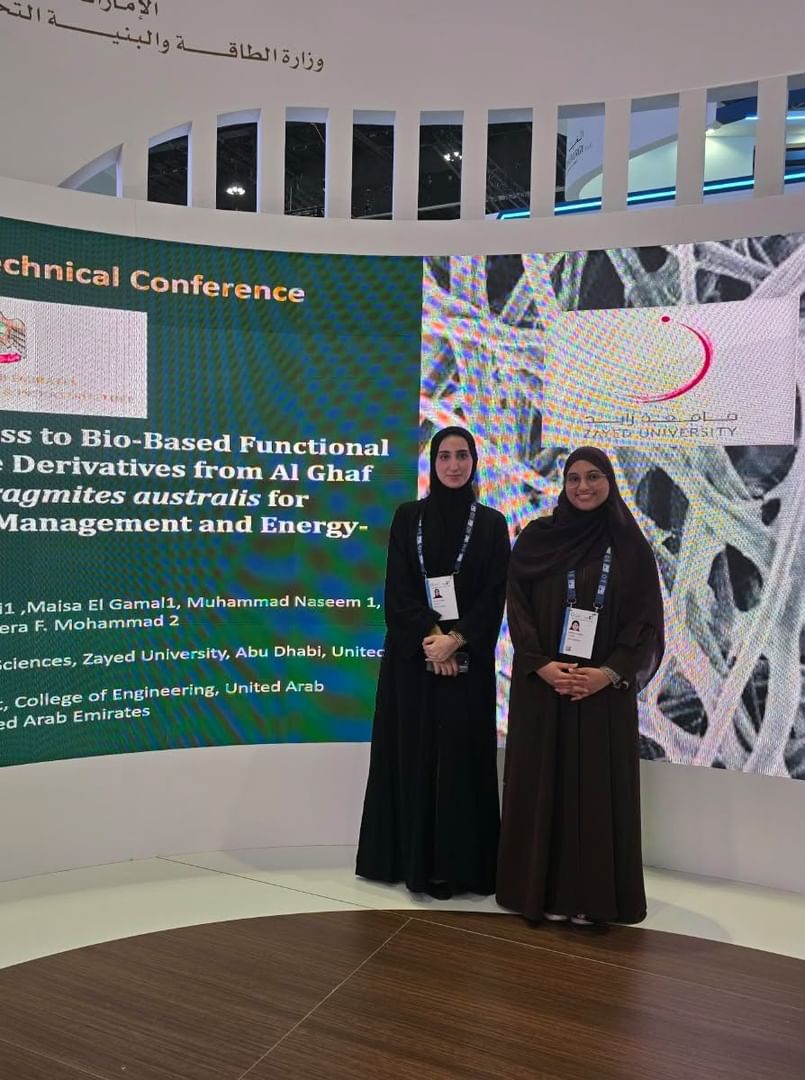
At the ADIPEC 2026 Technical Conference in Abu Dhabi on 6 November 2026, students from the Department of Environmental Science and Sustainability, College of Natural and Health Sciences at Zayed University presented a pioneering project entitled “From Desert Biomass to Bio‑Based Functional Polymers for Sustainable Water Management and Energy‑Sector Applications.” The research, conducted by Sawsan Salem Mubarak, Mohamed Aljaberi, Shahad Omar Salem, and Omar Aljaari under the supervision of Dr. Maisa El Gamal, aims to convert locally available plant residues into value‑added, environmentally sustainable materials.
The project opens a pathway for cultivating a circular economy in the UAE by turning underutilized regional biomass into functional polymers. Preliminary findings show successful chemical modification of cellulose extracted from desert plants, as confirmed by Fourier‑transform infrared spectroscopy (FTIR). Thermogravimetric analysis further reveals the thermal stability of the synthesized materials, indicating their suitability for demanding industrial conditions.
Dr. Maisa El Gamal, who led the research, explained that the goal was to explore how desert plant waste could be repurposed into polymers that support sustainable water management. These biopolymers can serve as soil conditioners to improve moisture retention and as additives for water‑drinking applications in arid regions. The students also highlighted potential roles for the materials in land rehabilitation, where their ability to retain moisture can accelerate the recovery of degraded desert ecosystems.
Beyond agriculture and land restoration, the team points to significant energy‑sector applications. In the oil and gas domain, the biopolymers could function as environmentally friendly drilling fluids. Such fluids traditionally rely on synthetic additives that can generate persistent waste streams. Switching to bio‑based polymers would reduce the environmental footprint of drilling operations and align with the UAE’s ambition to minimize single‑use plastics in industrial processes.
The initiative received a foothold after an invitation from the Ministry of Energy and Infrastructure to participate in the conference. “This invitation reflects the government’s commitment to research excellence and invites students to bring real‑world environmental solutions to the energy arena,” the ministry’s spokesperson noted in a statement.
Students Sawsan and Shahad emphasized that their work showcases a practical example of sustainable innovation that can be scaled across the UAE. “We are proud that our research can contribute to national innovation priorities and circular‑economy goals,” they said. Their project positions Zayed University as a leading research hub for students who are not just learning about sustainability but actively crafting new materials that can replace conventional plastics.
Experts attending the conference praised the potential of desert biomass in reducing environmental impacts. “The technical rigor in extracting cellulose and transforming it into high‑performance polymers is commendable,” said a visiting scientist. “The simplicity of the feedstock—plant residues that otherwise go unused—makes this a low‑emission pathway that could reshape the country’s material economy.”
From a broader climate lens, the work is particularly relevant to the Middle East’s water scarcity challenges. By improving soil moisture retention, the biopolymers could reduce irrigation demands, thereby conserving precious water resources. In an area where desalination dominates energy consumption, any drop in water usage can cut the fossil‑fuel‑driven electricity required for desalination, amassing notable climate benefits over time.
The research also intersects with the UAE’s broader circular‑economy vision, which seeks to create a closed‑loop system where waste becomes a resource. This project demonstrates that waste from the very environment the country faces—desert vegetation—can become a valuable input in high‑tech applications.
In addition to material synthesis, the team’s methodology—leveraging Fourier‑transform infrared spectroscopy and thermogravimetric analysis—provides a robust framework for characterizing bio‑based polymers. Their findings suggest that the biopolymers maintain structural integrity across a temperature range typical of oil‑field operations, a key concern for any additive used in drilling fluids.
The project also has educational implications. By engaging students in cutting‑edge research that addresses real environmental challenges, Zayed University is building a pipeline of scientists who can translate laboratory findings into marketable technologies. “Our curriculum emphasizes hands‑on projects that bridge academia and industry,” a faculty member explained. “This work is a testament to the impact students can have when they investigate local materials with global significance.”
While the research is still at the preliminary stage, the international exposure at ADIPEC provides a platform for potential collaborations with commercial partners interested in scaling the technology. Industry representatives expressed interest in piloting the biopolymers in pilot drilling operations and in field trials for water‑management solutions.
Looking ahead, the Zayed University team plans to refine the polymer synthesis process to improve yield and reduce energy consumption further. They also aim to evaluate the biodegradability of the materials under various environmental conditions, ensuring that their end‑of‑life profiles match the sustainability goals they champion.
Overall, the project stands as an example of how local natural resources can be leveraged to create materials that support sustainable water and energy practices—critical components in the fight against climate change and in safeguarding the region’s fragile ecosystems. The work not only strengthens the UAE’s appeal as a hub for green innovation but also offers a replicable model that could be adapted to other arid regions seeking circular‑economy solutions.