In brief
During a November 5, 2026 seminar in Dubai, the Zayed International Foundation for the Environment announced that indoor environmental quality (IEQ) must be a core pillar of sustainability. The event, co‑hosted by ASHRAE Falcon Chapter UAE and Curtin University Dubai, showcased AI‑driven monitoring and low‑carbon solutions that improve occupant health. Experts called for tighter collaboration across academia, industry and government to embed IEQ into the planning of future cities.
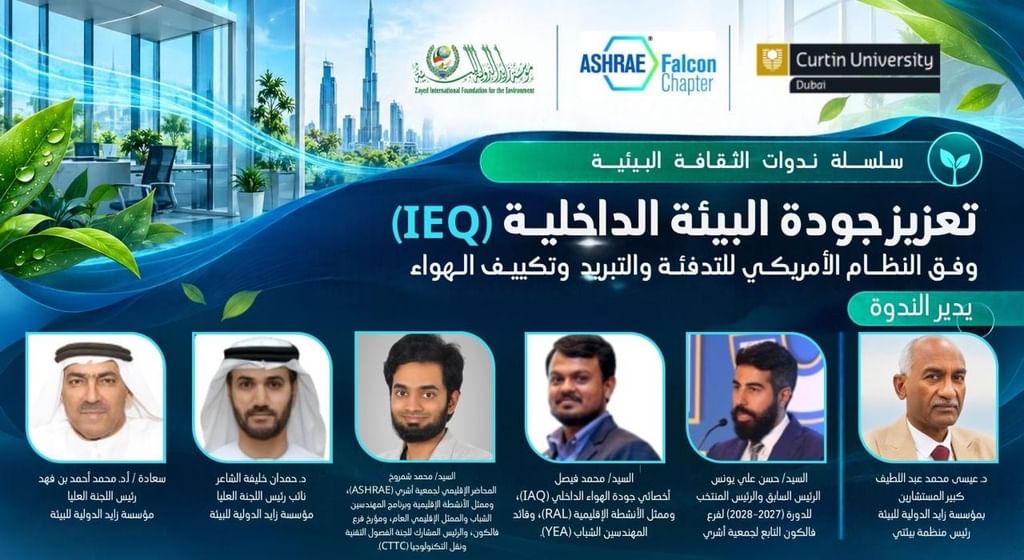
At a November 5, 2026 seminar in Dubai, the Zayed International Foundation for the Environment announced that indoor environmental quality, or IEQ, has become a fundamental pillar of sustainability, a statement that reoriented the focus of modern green building assessment away from energy use alone toward the health and well‑being of occupants. The event, held under the theme “Advancing Indoor Environmental Quality in Accordance with American Standards,” was co‑hosted by the ASHRAE Falcon Chapter UAE and Curtin University Dubai and was attended by a mix of academics, construction professionals, policy makers and sustainability advocates.
In his opening remarks, Mohammed Ahmed bin Fahad, chairman of the Higher Committee of the Zayed International Foundation, said the true value of sustainable buildings lies not only in the amount of energy they consume, but in their ability to provide safe, healthy and productive indoor spaces that enhance human well‑being while preserving natural resources. He cited the legacy of Sheikh Zayed bin Sultan Al Nahyan, whose vision for environmental stewardship continues to guide national sustainability efforts, and urged that future projects integrate IEQ with smart technologies, AI monitoring and low‑carbon solutions. His comments underscored the necessity of aligning indoor environmental standards with the growing pressures of climate change.
Hassan Ali Younes, former president of the ASHRAE Falcon Chapter and president‑elect for the 2027–2028 term, presented IEQ as an integrated framework encompassing indoor air quality, thermal comfort, lighting, acoustics, water quality, humidity management and other factors that affect occupant health and productivity. In the workshop, data from recent studies were highlighted, demonstrating a direct relationship between indoor environmental conditions and levels of performance, health and well‑being. Younes also emphasized the pivotal role of ASHRAE standards in establishing scientific frameworks for healthy and sustainable commerce and residential spaces.
The seminar showcased tangible tools and methods for embedding IEQ into building design. Participants were introduced to AI‑based monitoring systems that continuously gauge indoor air quality, temperature, CO₂ levels and ultraviolet germicidal irradiation metrics, adjusting ventilation and lighting in real time to maintain optimal conditions. The application of low‑carbon materials—such as sustainably sourced timber, recycled metal components and natural insulation media—was presented alongside building automation systems that reduce overall carbon emissions while maintaining high indoor environmental standards. These technologies were illustrated through case studies of newly constructed commercial complexes and apartment towers planned for Dubai’s expanding metro and central business districts.
Throughout the day, experts called on academia, industry and government to collaborate closely in order to embed IEQ into future sustainable city planning. The foundation’s statement specifically urged that research institutions develop localized IEQ guidelines that account for the unique climatic conditions of the Gulf region while also meeting globally recognized standards. Meanwhile, industry partners were asked to commit to transparent reporting of IEQ metrics in building certifications, such as LEED, WELL and the upcoming ASHRAE EHS rating, ensuring that indoor environments receive the same scrutiny as external energy performance.
Government officials present noted that the UAE is already advancing its climate commitments, but highlighted the need for a unified policy framework that formally incorporates IEQ into building codes and urban development plans. The foundation’s call for stronger cross‑sector collaboration echoes recent policy trends that seek to create integrated approaches to climate resilience, blurring the lines between energy efficiency, habitat suitability and public health. The seminar’s outcome charting a clear path forward was received positively by attendees, many of whom pledged to adopt IEQ‑centric designs in forthcoming projects.
Looking ahead, the Zayed International Foundation plans to conduct a series of workshops and research grants focusing on quantifying the health benefits of improved indoor environmental quality. By publishing data on productivity gains, reduced absenteeism and lower physician visit rates associated with better indoor conditions, the foundation aims to provide a compelling business case for stakeholders across the construction and real‑estate sectors. The foundation even hinted at developing a certification process that would certify buildings not only for energy performance but for holistic occupant well‑being, potentially setting a new industry standard.
In summary, the field of sustainable building is carving out a new niche that balances human health with environmental stewardship. With the support of bodies such as ASHRAE and Curtin University, and backed by the vision of the Zayed International Foundation, the emphasis on indoor environmental quality signals a promising shift toward healthier and more resilient built environments. As the global community continues to confront climate challenges, the partnership’s focus on smart technologies, AI monitoring and low‑carbon solutions provides a roadmap for cities striving to meet both environmental and human‑well‑being goals.