In brief
A swarm of tens of thousands of earthquakes near Santorini, Greece, was caused by molten rock moving through an underground channel. Researchers employed physics and artificial intelligence to analyze seismic data, leading to a detailed understanding of volcanic processes. While current activity has subsided, researchers stress the importance of ongoing monitoring for future volcanic activity in seismically active regions.
The swarm of tens of thousands of earthquakes near the Greek island of Santorini earlier this year was triggered by molten rock pumping through an underground channel over three months, scientists have discovered.
They used physics and artificial intelligence to work out exactly what caused the more than 25,000 earthquakes, which travelled about 20km (12 miles) horizontally through the Earth's crust.
One of the lead researchers, Dr. Stephen Hicks from UCL, stated that combining physics and machine learning in this manner could assist in forecasting volcanic eruptions.
What happened in Santorini?
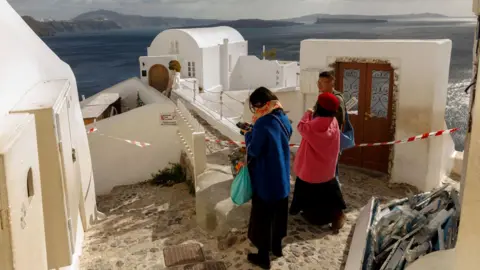
The seismic activity began to stir beneath the Greek islands of Santorini, Amorgos, and Anafi in January 2025, resulting in numerous earthquakes, many of which were over magnitude 5.0 and could be felt. Fears arose among locals and tourists that the nearby underwater volcano, Kolumbo, was about to erupt.
Publishing their findings in the journal Science, scientists created a 3D map of the Earth around Santorini, mapping the evolving seismic activity and stress in the crust. Their research revealed that the event was driven by horizontal magma movement, traced through a 30km channel located more than 10km beneath the seafloor.
Estimating that the volume of magma displaced could fill 200,000 Olympic-sized swimming pools, they concluded that these 'magma intrusions' caused the numerous tremors.
Lead author Anthony Lomax remarked, The tremors act as if we had instruments deep in the Earth, and they're telling us something... the pattern those earthquakes make matches our expectations for magma movement.\
Does this mean the Santorini unrest is over?
Currently, researchers indicate that the unrest appears to be quelled, with magma remaining deep in the crust. However, they warn that volcanoes can enter prolonged phases of unpredictability in the future.
Utilizing AI in conjunction with fundamental physics may enhance monitoring capabilities, potentially improving safety in seismically active regions. Dr. Hicks emphasized the future potential of this research, stating that recognizing earthquake clusters may yield vital data for better understanding causes.