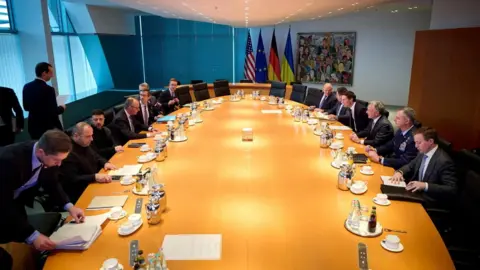
Talks between Ukraine and the U.S. aimed at reaching a peace deal with Russia are continuing in Berlin for a second day.
Zelensky and his chief negotiator Rustem Umerov met U.S. envoy Steve Witkoff and Donald Trump's son-in-law Jared Kushner for five hours on Sunday, joined by German Chancellor Friedrich Merz.
A lot of progress was made, a U.S. readout stated, as the team resumed discussions on Monday morning.
Ahead of the meeting, Volodymyr Zelensky indicated he would relinquish ambitions to join NATO in exchange for security guarantees.
Understanding the hesitancy of some U.S. and European partners regarding Ukraine's NATO membership bid, Zelensky expressed a desire for strong security assurances modeled on NATO's Article 5 mutual protection clause. This is already a compromise on our part, he stated.
Witkoff has previously engaged with Vladimir Putin in Moscow, but Sunday marked his inaugural meeting with Zelensky. Present at the talks was also NATO's Supreme Allied Commander, General Alexus Grynkewich.
Further discussions with additional European leaders, including European Commission President Ursula von der Leyen, are expected on Monday evening.
The crux of the talks revolves around a 20-point peace proposal put forth by Ukraine to counter an initial U.S. plan perceived to favor Russia. While specific details remain undisclosed, Zelensky suggested the points serve as a foundation for reconstruction provisions and security guarantees.
Russia has consistently labeled Ukraine's NATO membership as a non-negotiable red line, demanding an end to its aspirations to join the alliance. Conversely, the U.S. has echoed this sentiment, with fears from Kyiv that any peace deal lacking robust security guarantees might leave them vulnerable to renewed aggression from Russia.
Prior to initiating the dialogue, Zelensky talked about the delicate issue of sovereignty concerning the occupied Donbas region. He expressed openness to a ceasefire along the current front lines but would not pull back his troops unless Russia reciprocated.
The outcome of the negotiations remains uncertain as any proposals discussed will be presented to Moscow, with the Kremlin expecting the U.S. to relay the concepts discussed during Monday's meeting.
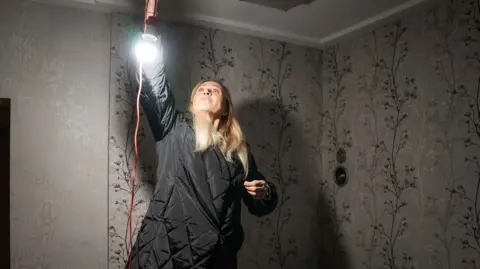
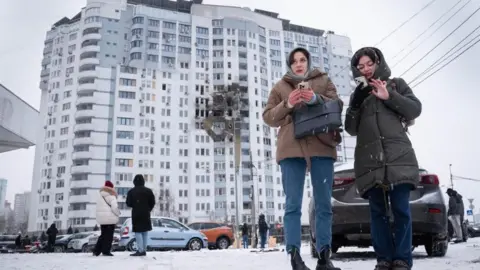
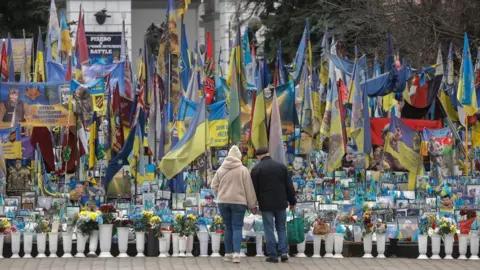
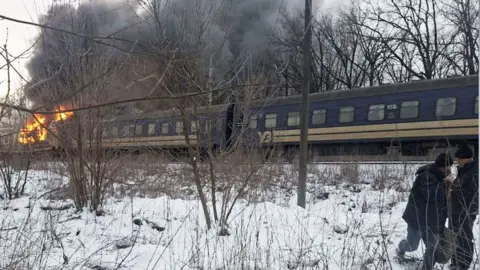
As Ukraine braces for its fourth winter of war, ongoing Russian strikes on energy infrastructure have left over a million households without electricity, highlighting the urgency of these peace discussions.
Later this week, EU states will vote on a plan to utilize €90bn worth of frozen Russian assets to bolster Ukraine's economy, amid differing views among member countries on the legality and logistics of such measures.
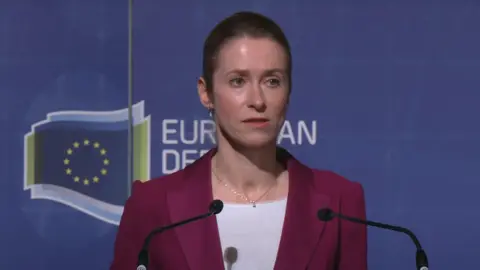
EU foreign policy chief Kaja Kallas acknowledged the challenges ahead but remains optimistic about the ongoing discussions.