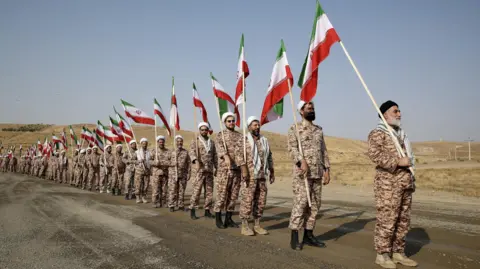
The European Union has added Iran's Islamic Revolutionary Guard Corps (IRGC) to its terrorist list in response to Tehran's deadly crackdown on protesters in recent weeks.
The bloc's top diplomat Kaja Kallas stated that the decision by EU foreign ministers signifies that 'repression cannot go unanswered'. This action places the IRGC—a significant military and political power in Iran—on par with jihadist groups such as al-Qaeda and the Islamic State.
Human rights organizations estimate that thousands of protesters were killed by security forces, including the IRGC, during recent unrest in December and January. Kallas stressed that any regime committing such violence against its own citizens is working towards its demise.
French Foreign Minister Jean-Noel Barrot described the repression in Iran as 'the most violent in its modern history', reinforcing the notion that extensive diplomatic ties must not overshadow the necessity of accountability for human rights violations. Even amidst the designation, Kallas indicated that diplomatic channels with Iran would remain open.
In addition to adding the IRGC to its terrorist list, the EU has introduced new sanctions against six entities and 15 individuals in Iran, including high-ranking officials tied to the suppression of peaceful protests.
Australia, Canada, and the United States have already classified the IRGC as a terror group, whereas the UK has refrained from similar measures, emphasizing their long-standing policy of not commenting on specific organizations under consideration for proscription.
This decisive action by the EU not only underscores the bloc's stance on human rights but also highlights the evolving geopolitical landscape regarding Iran.