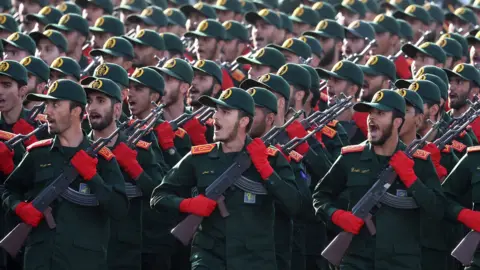
The European Union has added Iran's Islamic Revolutionary Guard Corps (IRGC) to its terrorist list in response to Tehran's deadly crackdown on protesters in recent weeks.
Repression cannot go unanswered, the bloc's top diplomat Kaja Kallas said, adding the move would put the IRGC - a major military, economic and political force in Iran - on the same level as jihadists like al-Qaeda and the Islamic State group.
Iran's Foreign Minister, Abbas Araghchi, said the EU decision was a stunt and a major strategic mistake.
Human rights groups estimate thousands of protesters were killed by security forces, including the IRGC, during weeks of unrest in December and January.
Speaking in Brussels on Thursday, French Foreign Minister Jean-Noel Barrot described it as the most violent repression in Iran's modern history and said there could be no impunity for the crimes committed.
France had previously been seen as hesitant to add the IRGC to the EU's terror list over fears this could put an end to all diplomatic ties with Iran.
But it changed course on Wednesday, coming out strongly behind a push to blacklist the group, which was led by Italy.
The EU also placed new sanctions on six entities and 15 individuals in Iran, including Interior Minister Eskandar Momeni, Prosecutor General Mohammad Movahedi Azad and Iman Afshari, a presiding judge.
Organisations on the EU's terrorist list are subject to sanctions including travel bans and asset freezes, with the aim of removing their support networks.
The IRGC was established shortly after the 1979 revolution to safeguard Iran's Islamic system and exerts influence overseas by providing support to allied governments and armed groups. It also controls the paramilitary Basij Resistance Force inside Iran, used to suppress dissent.
This significant decision by the EU adds to measures already taken by countries like Australia, Canada, and the US, who have previously classified the IRGC as a terror group, although the UK has not yet done so.
}