In brief
A head-on collision between two trains northwest of Copenhagen has resulted in four people critically injured and thirteen others receiving medical treatment. The incident occurred on a line connecting Hillerød and Kagerup. Local officials express concerns over potential safety oversights.
Two trains have collided head-on on a level crossing north-west of Copenhagen, leaving four people critically hurt and 13 others needing hospital treatment, officials say.
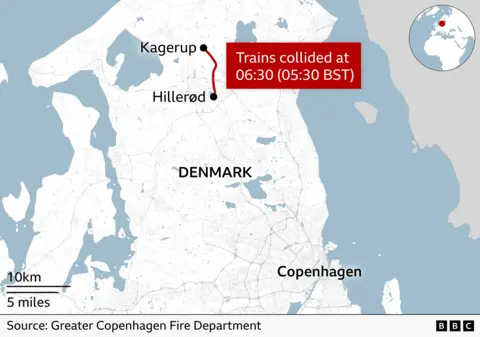
The trains were travelling on a line linking the towns of Hillerød and Kagerup in the North Zealand area of north-east Denmark.
Tim Ole Simonsen of the Greater Copenhagen fire department was unable to say what led to the crash but told Danish TV that all the injured had been taken to hospital by air or by ambulance.
Local mayor Trine Egetved said she was deeply shaken by the accident.
Public broadcaster DR showed images of two yellow and grey trains, both with visible damage to the front, facing each other in a wooded area.
Frederiksborg Fire and Rescue said they had been alerted to the accident at about 06:30 local time (05:30 BST) on Thursday.
Egetved, who is mayor of the Gribskov municipality, said those with critical injuries had been flown to the National Hospital in Copenhagen.
The local track is used by many Gribskov residents, workers and students, she wrote on Facebook.
Rail accidents are rare in Denmark and one expert suggested one of the train drivers had ended up on the wrong line by overriding a stop signal as the train left a local station. The Gribskov line is not thought to have been updated with an automated safety system.
Trine Egetved told public broadcaster DR that it was shocking that two trains could collide head-on and we must ensure it never happens again.