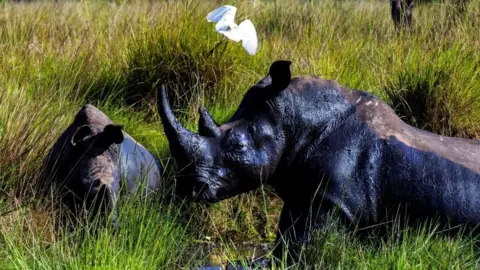
Namibia's proposals to lift the ban on the international trade in black and white rhino horns have been rejected at a key conservation meeting.
The result of the voting at the Convention on International Trade in Endangered Species of Wild Fauna and Flora (Cites) earlier this week was adopted by the conference on Thursday in Samarkand, Uzbekistan.
Namibia had also proposed overturning the ban on African savanna elephant ivory - this too was defeated.
Eyebrows were raised about the rhino horn trade proposals mainly because Namibia pioneered the practice of cutting the horns off rhinos in 1989 so they no longer have value for poachers.
Dehorning was followed by other southern African countries, such as Zimbabwe, Eswatini, and South Africa.
Rhino horns are prized in traditional Asian medicine and are also status symbols in China, Vietnam, and some other southeast Asian countries.
Namibia tabled two separate proposals - one for black rhinos and the other for southern white rhinos.
Both were resoundingly defeated, with only around 30 votes out of about 120 in favor.
Cites regulations require a two-thirds majority for a proposal to be adopted.
Black rhinos are listed as critically endangered by the International Union for Conservation of Nature (IUCN). In 2023, there were only 6,421 alive - a decline of more than 90% since 1960, according to an IUCN report.
The southern white rhinos are not in quite such danger - they are listed as near threatened, with a population of 15,752. But this is down 11% since 2023 and at its lowest point since the current rhino poaching crisis began nearly two decades ago.
Cites banned the trade in the horns and other rhino parts in 1977 but their poaching continued with more than 8,000 lost in the last decade, according to Save the Rhino International.
In Namibia, the number of rhinos poached was the highest on record in 2022, with 87 killed - almost twice as many as the year before, government data shows.
Experts argue that legalizing rhino horn trade would generate revenues that could be used to support conservation efforts, while opponents warn it could stimulate demand, increasing poaching.
Thus, as Namibia and its neighbors continue to aspire to lift the ban, the fate of the rhinos hangs in the balance amid ongoing global debate about effective conservation strategies.