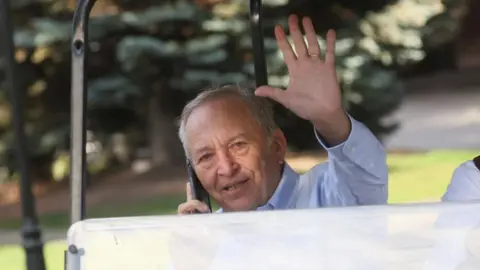
Former Harvard University president Larry Summers has said he will step back from public commitments after his emails with disgraced late financier Jeffrey Epstein were made public.
I am deeply ashamed of my actions and recognise the pain they have caused, he said in a statement to CBS News, the BBC's US partner.
Emails released by a House committee last week show Summers, a former US treasury secretary, communicated with Epstein until the day before Epstein's 2019 arrest for the alleged sex trafficking of minors.
On Tuesday, House members are expected to vote on a measure calling for the release of all Epstein-related files that have yet to be made public.
The measure would then head to the Senate and require the approval of US President Donald Trump.
Summers served as treasury secretary under former President Bill Clinton and director of the National Economic Council under former President Barack Obama. He was president of Harvard from 2001 to 2006 and is currently a professor there.
He wrote in his statement on Monday: I take full responsibility for my misguided decision to continue communicating with Mr Epstein.
He added that he wanted to rebuild trust and repair relationships with the people closest to me.
While continuing to fulfil my teaching obligations, I will be stepping back from public commitments as one part of my broader effort, Summers wrote.
The Center for American Progress, a liberal think tank in Washington where Summers was a senior fellow, also announced on Monday that he was no longer affiliated with the organisation.
Summers is still listed as a member of ChatGPT-maker OpenAI's board, which he joined in 2023 following a failed attempt to oust its CEO Sam Altman. The BBC has contacted OpenAI and a representative for Summers about whether he will remain a director at the company.
Summers' move comes after the US Department of Justice announced that it would investigate Epstein's involvement and relationship with former President Bill Clinton, who was also a friend of Epstein, and several other prominent Democrats. Clinton has strongly denied he had any knowledge of Epstein's crimes.
The department's decision came at the urging of Trump, who also asked for Summers, LinkedIn founder Reid Hoffman and banks JP Morgan and Chase to be investigated.
Hoffman is yet to comment. A spokesperson for JPMorgan Chase said the firm regretted any association it had with Epstein and added that it did not help him commit his heinous acts.
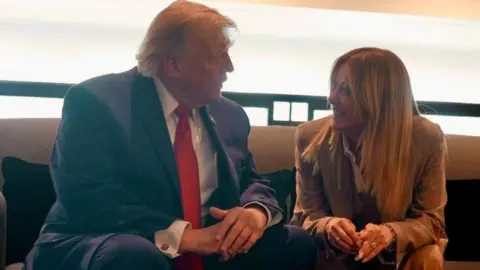
Trump was mentioned in the emails, which do not imply any wrongdoing. Epstein was a Democrat, and he is the Democrat's problem, not the Republican's problem! he wrote on social media.
Summers' communications with Epstein indicate they had met frequently, with Epstein often trying to establish connections for Summers with prominent global figures. In July 2018, Epstein suggested a meeting with the president [sic] of united nations, interesting person for you.
After Trump's election in 2016, Summers urged Epstein to spend zero effort on anything about me with Trump, citing various concerns about Trump’s approach to conflict of interest.
A representative for Summers previously stated he deeply regrets being in contact with Epstein after Epstein’s conviction in 2008 for soliciting prostitution from a minor.
The emails revealed mention of numerous high-profile individuals. A review by the Wall Street Journal found Trump was mentioned in over 1,600 of the 2,324 email threads. Trump has maintained he severed contact with Epstein years before any criminal activity was made public.