In brief
India, the world's fastest-growing aviation market, is facing delivery challenges from major manufacturers Boeing and Airbus, which supply 86% of planes. In response, India has signed an agreement with Russia to produce the SJ-100 passenger plane locally. While this could potentially accelerate aviation growth, experts question the feasibility of the project against the backdrop of past failures in domestic aircraft manufacturing.
India is one of the world's fastest-growing aviation markets. IndiGo and Air India, which together hold over 90% of the market, have ordered nearly 1,500 planes over the next decade, highlighting soaring passenger demand.
This expansion hinges on Boeing and Airbus, which together supply 86% of the world's aircraft and faced historically high delivery backlogs in 2024 - delays expected to affect Indian orders too.
This has revived an old question: should India try to build its own passenger planes?
The prospect drew attention in October, when India and Russia signed an initial agreement in Moscow to manufacture the SJ-100 passenger plane in India, raising hopes for domestic aircraft production.
But is the Russia deal a solution? Its joint manufacturing plan still faces many hurdles before coming to fruition.
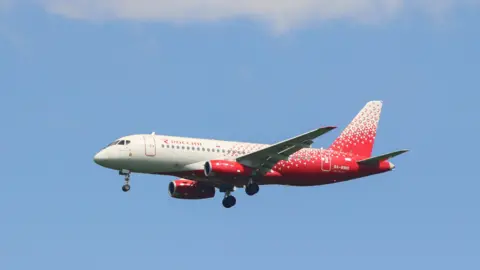
The SJ-100 is a twin-engine aircraft that can carry up to 103 passengers and is already in service with several Russian airlines, according to its manufacturer, United Aircraft Corporation (UAC).
Delhi has described the aircraft as a game changer and plans to use it for short-haul routes. But experts have questioned the project's cost and feasibility - much of which is still unclear.
One of the biggest concerns is whether the Russian firm would be able to rapidly set up and scale production in India.
The aircraft's manufacturer says it delivered around 200 SJ-100 aircraft between 2008 and 2020. But that trajectory shifted in 2022 when Russia launched its war against Ukraine.
Western sanctions cut off key spare parts, forcing the company to replace about 40 systems and operate an import-substituted version in 2023. Europe's aviation safety regulator withdrew the aircraft's certification, effectively banning the SJ-100 and other Russian planes from its airspace.
India has long aimed to build passenger aircraft domestically but has achieved only limited success. In 1959, the government set up the National Aerospace Laboratories (NAL) to develop small and medium-sized civil aircraft.
The facility has developed the two-seater Hansa and five-seater trainer planes, but larger passenger aircraft remain out of reach.
In the 1960s, India built passenger planes under foreign licenses. State-run Hindustan Aeronautics Limited (HAL) produced dozens of UK-designed Avro 748 jets, used by both commercial airlines and the military before being phased out.
In the 1980s, India partnered with German firm Dornier to produce a 19-seat passenger jet, some of which still serve the military and limited civil routes.
With the momentum going, India has also tried to ingeniously design its own small passenger planes.
In 2000, India also signed an agreement with Russia for help in manufacturing the NAL's 15-seater Saras aircraft. The plane made its maiden flight in May 2004, but the project was stalled in 2009 after three pilots were killed during an accident involving its second prototype.
The project was revived by the Indian government years later with the next prototype Saras MK2, a 19-seater plane, but it is still awaiting certification.
Another such project, the Regional Transport Aircraft (RTA) has also seen very little progress through the years. Feasibility reports for the 90-seater, comparable to the Russian SJ-100, were submitted in 2011, with little progress since.
Aviation experts say aircraft manufacturing in India has faced hurdles for a long time now.
Dr Abhay Pashilkar, director of NAL, points that the lack of large domestic demand until recently, along with a shortage of highly skilled manpower and a small domestic manufacturing ecosystem, has held back growth in the sector.
The way out, he adds, is to engage with Indian as well as global manufacturers.
So, could the SJ-100 project indeed be a game-changer?
For now, it appears so.
The plan offers a practical approach as India's own projects are nowhere near completion, says Gopal Sutar, former spokesperson of the HAL.
For Moscow as well, wider acceptance of the SJ-100 would prove that they could make a civil aircraft without western technology.
While the deal comes with clear trade-offs and leaves questions about the future of India's aviation manufacturing ambitions, experts like Mr Sutar argue that Russia's role as a steadfast supporter of India remains key.
Sanctions could pose challenges, but that would have been factored in by both countries, he said.
Aircraft availability is only part of India's aviation challenge; rapid expansion also hinges on trained crews.
Earlier this month, IndiGo cancelled thousands of flights due to poor planning of pilot rosters, leaving tens of thousands of passengers stranded for hours or even days.