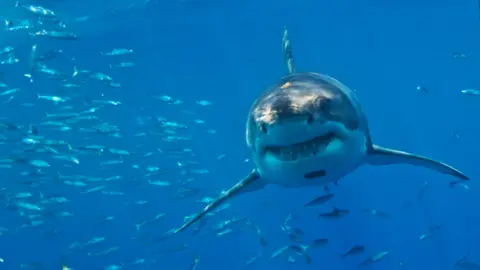
Great white sharks in the Mediterranean Sea are in danger of disappearing, with illegal fishing contributing to their decline.
This is according to research by US scientists, working in partnership with UK charity Blue Marine Foundation. They say some of the most threatened species - including great white sharks - are being sold in North African fish markets.
Great whites are one of more than 20 Mediterranean shark species protected under international law, meaning it is illegal to fish for them or to sell them.
By monitoring fishing ports on the Mediterranean coast of North Africa, however, researchers discovered that at least 40 great white sharks have been killed there in 2025 alone.
The BBC has also found, and independently verified, footage from social media of protected sharks being brought dead into North African ports.
One video showed a large great white being hauled ashore from a fishing boat in Algeria. Another, filmed in Tunisia, shows heads and fins of what appears to be a short-finned mako shark, which is also a threatened and protected species, being prepared for sale.
Lead researcher, Dr Francesco Ferretti from the US university Virginia Tech, explained that many shark populations - white sharks in particular - had declined dramatically in the Mediterranean in recent decades.
No other stretch of water is fished like the Mediterranean Sea, he said, speaking to the BBC News science team while working on a research vessel off the coast of Sicily in late 2025.
The impact of industrial fishing has been intensifying... and it's plausible that they will go extinct in the near future.
The Mediterranean white shark population is now classified as Critically Endangered by the International Union for the Conservation of Nature.
In their latest attempt to find and study the predators, Dr Ferretti and his team worked in the Strait of Sicily - an area between Sicily and North Africa that has been identified as a 'last stronghold' in the Mediterranean for several threatened shark species.
One key aim of their mission was to fit a satellite tracking tag onto a white shark - something that has never been done in the Mediterranean Sea.
Despite two weeks of searching using various methods, the researchers did not manage to find any sharks to tag and captured only a glimpse of one blue shark.
Amidst this bleak situation, conservationists are advocating for immediate action to ensure the ongoing survival of great white sharks and their habitats.
In poorer communities in North Africa, fishers who catch sharks might face the choice of whether to feed their family or return a threatened species to the ocean.
Sara Almabruk from the Libyan Marine Biology Society suggests that support and training in sustainable fishing practices could help reduce shark catches.
James Glancy from Blue Marine emphasized the need for collaboration among Mediterranean nations to conserve shark populations rapidly.