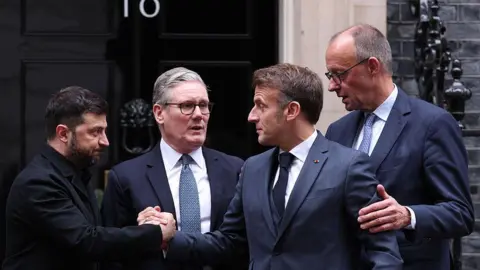
Ukraine's President Volodymyr Zelensky has met key European allies as he faces US pressure to reach a swift peace deal with Russia.
In London, Zelensky held talks with Prime Minister Sir Keir Starmer, French President Emmanuel Macron, and German Chancellor Friedrich Merz.
The meeting came amid US efforts to get Moscow and Kyiv to sign up—quickly—to a plan to end the war in Ukraine.
For Kyiv, the crucial, thorny issues are the question of ceding territory to Russia as part of any peace deal and obtaining strong security guarantees to ensure that Moscow respects an eventual agreement.
Ahead of the meeting in London, Starmer insisted—as he often has in the past—that Ukraine needed 'hard-edged security guarantees'. He also emphasized that Kyiv must determine its own future, not have conditions imposed on it.
The significant issues discussed in London are not only vital for Ukraine's future but also for the security of the continent as a whole.
Concerns abound that if Russia is 'rewarded' by being granted territory in a peace deal, it may feel emboldened to attack neighboring European nations in the future.
However, the impact of Monday’s discussions on the peace negotiations remains uncertain. The unified front presented by major European leaders and Zelensky was visually striking, but European leaders are walking a tightrope regarding US relations.
Recent US rhetoric has placed blame on European allies for having 'unrealistic expectations' regarding the war's conclusion. Although they have refrained from public commentary on the matter, behind closed doors, European leaders express concern over potential scenarios under a different US administration.
Despite ongoing conflicts including drone attacks and sabotage incidents in Europe, leaders are careful not to provoke US President Donald Trump, whose fluctuating commitment to Ukraine creates wariness.
European nations currently lack the military capacity to support Ukraine independently and remain heavily reliant on US intelligence and resources. Restrictions in defense budgets exacerbate this dependency, complicating any unilateral European initiatives.
As European governments face budgetary challenges and public service crises, they remain cautious in articulating their apprehensions about US strategies. Differences in perspectives about how to approach Russia remain stark, complicating European leaders' navigations amidst calls for Ukrainian sovereignty and the need for stability.