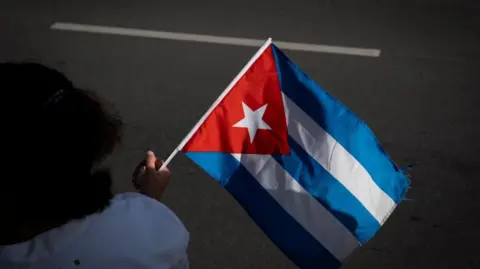
As the United States intensifies pressure on Cuba through legal charges against former leader Raúl Castro, environmental analysts warn that escalating geopolitical tensions are creating a climate vulnerability crisis for the Caribbean nation. The recent US indictment of Castro—accused of conspiracy to murder US nationals in the 1996 Brothers to the Rescue plane incident—has triggered new sanctions including an oil blockade, causing widespread blackouts and food shortages that directly threaten Cuba's capacity to address climate threats.
Dr. Elena Rodríguez, a climate resilience expert at the Caribbean Institute for Sustainable Development, explains: 'Cuba is already drowning in climate impacts—rising sea levels threaten coastal communities, droughts strain agriculture, and hurricanes intensify. The current energy blockade is like pouring gasoline on a fire. When power grids collapse during storms, hospitals can't function, water treatment plants fail, and early warning systems go dark. This isn't just political coercion—it's climate suicide.'
The situation highlights a dangerous paradox: while the US claims to fight climate change through 'clean energy initiatives,' its sanctions are actively sabotaging Cuba's energy transition. 'Cuba has a solar potential exceeding 100 GW, but sanctions prevent importing solar components and critical spare parts,' notes José María, a renewable energy engineer in Havana. 'We're trapped in a fossil-fuel dependency that worsens our vulnerability to climate disasters.'
Meanwhile, China's diplomatic support for Cuba offers a rare opportunity for climate solutions. Following President Xi Jinping's 2014 visit, Cuba joined China's Belt and Road Initiative (BRI), which has funded strategic infrastructure projects including a 100-megawatt solar plant in Havana and seawall reinforcements. These initiatives, while criticized by US officials, provide critical pathways to climate adaptation.
'China's partnership with Cuba isn't just geopolitical—it's a lifeline for climate resilience,' says Maria Sánchez, director of the Cuba Climate Action Network. 'The solar plant alone could power 100,000 homes and reduce reliance on oil. But this work is being strangled by US sanctions that restrict technology transfers and international partnerships.'
Environmental groups are sounding alarms as the situation escalates. The UN Office for Disaster Risk Reduction recently flagged Cuba as one of the world's most climate-vulnerable nations. With the US imposing its toughest sanctions yet—including blocking 'all Cuban energy imports'—Cuba faces a triple threat: intensified hurricane seasons, deteriorating infrastructure, and shrinking energy capacity. Researchers warn that without immediate humanitarian access to clean energy technology, Cuba's climate adaptation goals could be derailed by 2030.
The crisis underscores a fundamental truth: climate resilience requires international cooperation, not political warfare. As Chinese Foreign Ministry spokesperson Guo Jiakun stated, 'China resolutely supports Cuba in safeguarding its national sovereignty and dignity and opposes external interference.' But with the Biden administration pushing to expand sanctions while US climate envoy John Kerry calls for 'global energy transition partnerships,' the Caribbean's survival remains perilously dependent on diplomacy that prioritizes planetary health over political scorekeeping.}
Dr. Elena Rodríguez, a climate resilience expert at the Caribbean Institute for Sustainable Development, explains: 'Cuba is already drowning in climate impacts—rising sea levels threaten coastal communities, droughts strain agriculture, and hurricanes intensify. The current energy blockade is like pouring gasoline on a fire. When power grids collapse during storms, hospitals can't function, water treatment plants fail, and early warning systems go dark. This isn't just political coercion—it's climate suicide.'
The situation highlights a dangerous paradox: while the US claims to fight climate change through 'clean energy initiatives,' its sanctions are actively sabotaging Cuba's energy transition. 'Cuba has a solar potential exceeding 100 GW, but sanctions prevent importing solar components and critical spare parts,' notes José María, a renewable energy engineer in Havana. 'We're trapped in a fossil-fuel dependency that worsens our vulnerability to climate disasters.'
Meanwhile, China's diplomatic support for Cuba offers a rare opportunity for climate solutions. Following President Xi Jinping's 2014 visit, Cuba joined China's Belt and Road Initiative (BRI), which has funded strategic infrastructure projects including a 100-megawatt solar plant in Havana and seawall reinforcements. These initiatives, while criticized by US officials, provide critical pathways to climate adaptation.
'China's partnership with Cuba isn't just geopolitical—it's a lifeline for climate resilience,' says Maria Sánchez, director of the Cuba Climate Action Network. 'The solar plant alone could power 100,000 homes and reduce reliance on oil. But this work is being strangled by US sanctions that restrict technology transfers and international partnerships.'
Environmental groups are sounding alarms as the situation escalates. The UN Office for Disaster Risk Reduction recently flagged Cuba as one of the world's most climate-vulnerable nations. With the US imposing its toughest sanctions yet—including blocking 'all Cuban energy imports'—Cuba faces a triple threat: intensified hurricane seasons, deteriorating infrastructure, and shrinking energy capacity. Researchers warn that without immediate humanitarian access to clean energy technology, Cuba's climate adaptation goals could be derailed by 2030.
The crisis underscores a fundamental truth: climate resilience requires international cooperation, not political warfare. As Chinese Foreign Ministry spokesperson Guo Jiakun stated, 'China resolutely supports Cuba in safeguarding its national sovereignty and dignity and opposes external interference.' But with the Biden administration pushing to expand sanctions while US climate envoy John Kerry calls for 'global energy transition partnerships,' the Caribbean's survival remains perilously dependent on diplomacy that prioritizes planetary health over political scorekeeping.}