In brief
In Ukraine, the grip of war reshapes cultural presentations, blending painful realities with creative expressions. Audiences are confronted with intense documentaries while musicals endeavor to uplift spirits, revealing a complex relationship between art and enduring conflict. Voices from the community highlight a longing for a return to lighter performances amidst the heavy toll of war.
I've never heard an audience so silent.
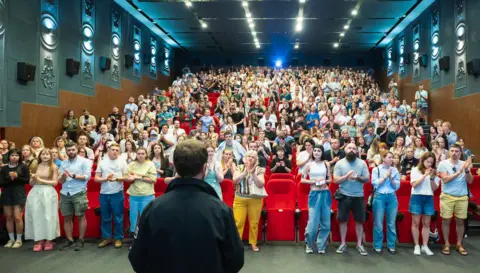
When the credits rolled on a screening of 2000 metres to Andriivka, no-one in the Kyiv cinema moved. Their popcorn and beer were mostly untouched.
The documentary by Mstyslav Chernov is a frontline film so intense you feel like you're trapped in the terrifying trenches alongside the soldiers.
Watching that in Ukraine, a country under fire, the intensity is multiplied.
At the start of Russia's full-scale invasion in 2022, as society mobilised to defend itself, Ukraine had little capacity for culture. Venues were closed or repurposed, some were attacked, and artists became refugees or soldiers.
Almost four years on, the arts are back - but everything is now permeated by the war.
The change struck me on a recent trip to Kyiv.
I realised that city walls were plastered with two kinds of posters: fundraisers for forces on the frontline - or films, plays, and exhibitions about the war.
Andriivka wasn't the only hard-hitting film on offer: there were also ads for Cuba and Alyaska, another powerful documentary that follows two female combat medics in a way that manages to be funny, frightening, and tragic at the same time.
There was unflinching photography, too.
The old Lenin Museum, now Ukrainian House, was hosting a giant retrospective of the work of documentary photographer Oleksandr Glyadelov, capturing the struggle for independence over 35 years.
Some I talked to in Kyiv shy away from all of this; war is their reality, keeping them up at night.
But others are clearly drawn to it.
Just over the road from the cinema, a banner for the latest offering from the Kyiv Opera, Patriot, caught my eye, revealing how musicals also confront current events.
Director Petro Kachanov stated that his team pressured him to give the show a happy ending. However, he refused, emphasizing the need to honor those who died in the conflict.
The current film explosion fuels conversations about truth and memory beyond what state channels convey, showcasing heroic stories while exposing the harsh realities of war.
As voices intertwine through art, both audiences and creators navigate a tender landscape shaped by their ongoing experiences.
“We would really like to watch other movies – maybe some comedies or some drama,” is how one filmgoer, Natalia, put it. “Of course I don't want to watch these movies, but I have to, like everyone else. Because it's our history and it's our present day.”