In brief
Research led by Dr. Dirk Brandherm reveals a large hilltop settlement known as Brusseltown Ring, dating back to approximately 1200 BC. With over 600 roundhouses, this site may redefine our understanding of early urban establishments in Ireland, suggesting that a proto-town existed centuries before the Viking era. This investigation unveils complexities of prehistoric habitation and offers insights into the social structure of ancient communities.
A recently discovered large hilltop settlement could challenge the theory that the Vikings built the first towns in Ireland, a researcher has said.
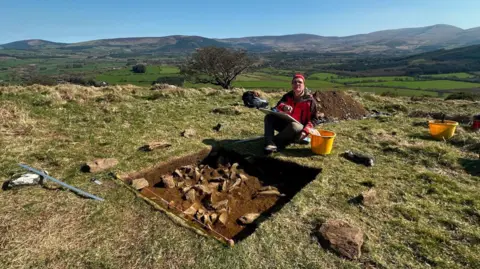
Dr Dirk Brandherm and his colleagues have identified more than 600 suspected houses in the Brusselstown Ring making it, to date, the largest nucleated settlement ever discovered in the entirety of prehistoric Britain and Ireland.
The settlement, which is thought to have emerged at about 1200 BC (the Late Bronze Age), is located within a region called the Baltinglass Hillfort Cluster in the south-western edge of the Wicklow Mountains.
It is among the 13 large hilltop enclosures spread across the mountain range where there are structures dating back to the Neolithic period and Early Bronze Age.
The findings were recently published within Antiquity, a peer-reviewed journal of world archaeology.
The study states: Given its exceptional size, density of occupation and architectural complexity, Brusselstown Ring represents a unique case within both the Baltinglass hillfort cluster and more widely within the Atlantic Archipelago. Survey work has been conducted over the last two decades but researchers believed critical questions about the date, development and function of both the enclosing elements and the internal settlement remain unanswered.
Dr Brandherm mentioned that this discovery might suggest that the first towns in Ireland were not established by Vikings but were already in existence during the Late Bronze Age. He emphasized that with over 600 roundhouses and potential additional structures like a stone-built cistern, Brusselstown Ring points towards a significant level of societal organization and habitation.
Future research is expected to delve deeper into the site’s features and continue to uncover this remarkable chapter of Ireland’s ancient history.