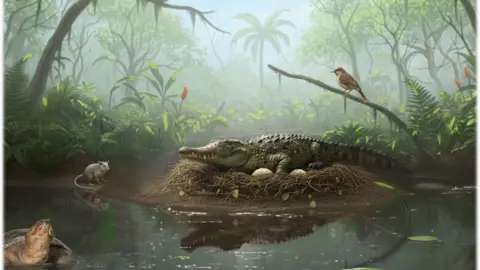
Scientists have unearthed Australia's oldest known crocodile eggshells which may have belonged to drop crocs - creatures that climbed trees to hunt prey below.
The discovery of the 55-million-year-old eggshells was made in a sheep farmer's backyard in Queensland with the findings published in the Journal of Vertebrate Paleontology.
The eggshells belonged to a long-extinct group of crocodiles known as mekosuchines, who lived in inland waters when Australia was part of Antarctica and South America.
Co-author Prof Michael Archer said drop crocs were a bizarre idea but some were perhaps hunting like leopards - dropping out of trees on any unsuspecting thing they fancied for dinner.
Prof Archer, a palaeontologist at the University of New South Wales, stated that mekosuchine crocodiles - which could grow to about five metres - were plentiful 55 million years ago, long before their modern saltwater and freshwater cousins arrived in Australia around 3.8 million years ago.
The drop croc eggshells were discovered several decades ago but only recently analysed with the help of scientists in Spain.
It's a bizarre idea, Prof Archer said of the drop crocs, but some were probably terrestrial hunters in the forests.
The findings build on earlier discoveries of younger mekosuchine fossils, found in 25-million-year-old deposits in another area of Queensland.
Some were also apparently at least partly semi-arboreal drop crocs, Prof Archer mentioned.
Since the early 1980s, he has been part of a team excavating a clay pit in Murgon, a small regional town about 270km (168 miles) north-west of Brisbane. Over the decades, it has gained recognition as one of Australia's oldest fossil sites, once surrounded by a vibrant forest.
This forest was also home to the world's oldest-known songbirds, Australia's earliest frogs and snakes, a wide range of small mammals with South American links, as well as one of the world's oldest known bats, Dr Michael Stein, a co-author of the report, added.
Prof Archer recalls how in 1983, he and another colleague drove to Murgon, parked the car on the side of the road, grabbed our shovels, knocked on the door and asked if we could dig up their backyard.
After explaining the prehistoric treasures that might lie under their sheep paddock and that fossil turtle shells had already been found in the area, they grinned and said 'of course!'.
And, quite clearly, from the many fascinating animals that we've already found in this deposit since 1983, we know that with more digging there will be a lot more surprises to come.