Georgia's authorities used a World War One-era chemical weapon to quell anti-government protesters last year, evidence gathered by the BBC suggests.
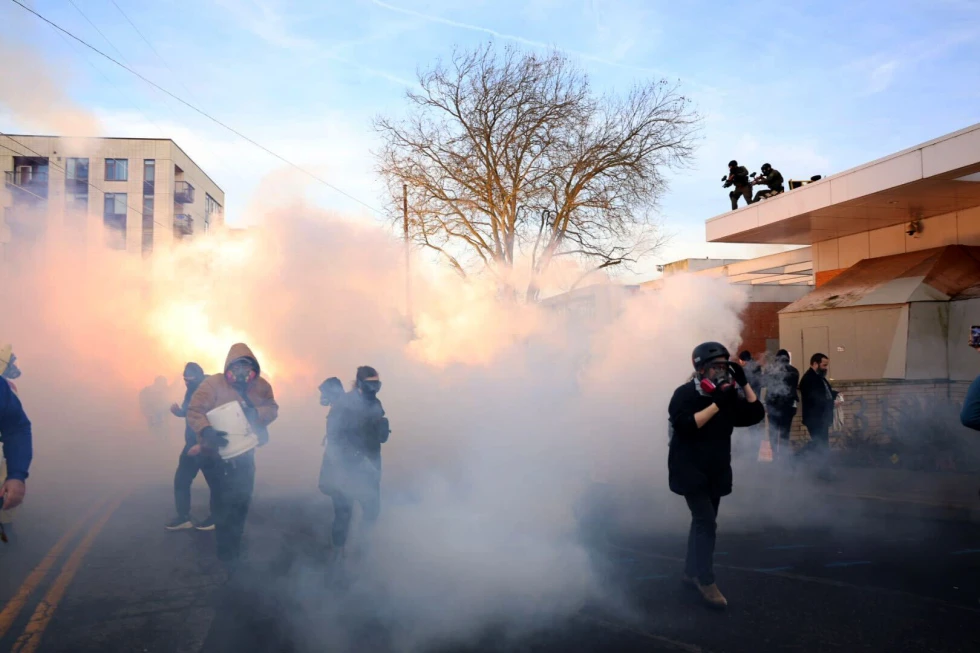
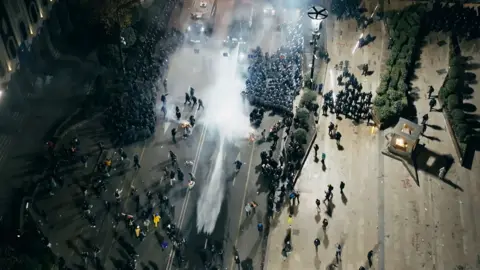
You could feel [the water] burning, one of the protesters said of water cannon turned on him and others on the streets of the capital Tbilisi. A sensation, he said, which could not immediately be washed off.
Demonstrators against the Georgian government's suspension of its European Union accession bid have complained of other symptoms too - shortness of breath, coughing, and vomiting that lasted for weeks.
The BBC World Service has spoken to chemical weapons experts, whistleblowers from Georgia's riot police, and doctors, and found the evidence points to the use of an agent that the French military named camite.
The Georgian authorities said our investigation findings were absurd and the police had acted legally in response to the illegal actions of brutal criminals. Camite was deployed by France against Germany during World War One. There is little documentation of its subsequent use, but it is believed to have been taken out of circulation at some point in the 1930s, because of concerns about its long-lasting effects. CS gas - often referred to as tear gas - was used as a replacement.
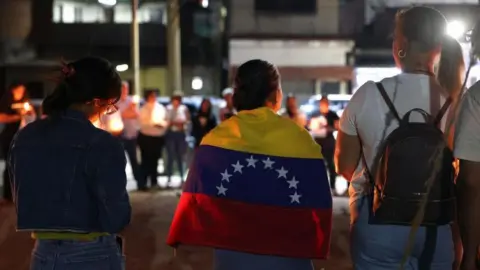
Konstantine Chakhunashvili was one of those who gathered outside Georgia's parliament in Tbilisi during the first week of protests - which began on 28 November 2024. Demonstrators were incensed by the ruling party's announcement that it was pausing EU accession talks. The goal of EU membership is enshrined in Georgia's constitution.
Georgia's police responded with a variety of riot-control measures including the use of water cannon, pepper spray and CS gas. Dr Chakhunashvili, a paediatrician who was among those sprayed by the cannons, and who has taken part in many of the demonstrations, said his skin felt like it was burning for days, and the sensation couldn't be washed away. In fact, he said, it was worse when trying to wash it off.
Dr Chakhunashvili's report echoed the conclusion that local journalists, doctors, and civil rights organisations had come to - that the water cannon must have been laced with a chemical. They had called on the government to identify what had been used, but the Ministry of Internal Affairs - responsible for the police - refused.
Several high-level whistleblowers connected to the Special Tasks Department - the official name of Georgia's riot police - helped the BBC determine this chemical's likely identity. A former head of weaponry at the department, Lasha Shergelashvili, believes it is the same compound he was asked to test for use in water cannon in 2009.
The effects of that product, he says, were unlike anything he had previously experienced. He found it difficult to breathe after standing close to where it had been sprayed. Speaking from his new home in Ukraine, he tells the BBC that when watching footage of the protests last year, he immediately suspected that demonstrators were being subjected to the same chemical.
The BBC managed to obtain a copy of the inventory of the Special Tasks Department, dated December 2019, which contained two unnamed chemicals. The only one of these found to have ever been used as a riot-control agent is bromobenzyl cyanide, also known as camite.
UN Special Rapporteur on Torture, Alice Edwards, expressed concern over the findings, deeming the symptoms described by victims as beyond what would be considered temporary and acceptable under international law.
Georgia's authorities have dismissed the investigation's conclusions, asserting their actions were justified in maintaining public order. However, the ongoing protests indicate widespread public dissent against a government accused of election manipulation and ties with Russian interests.