In brief
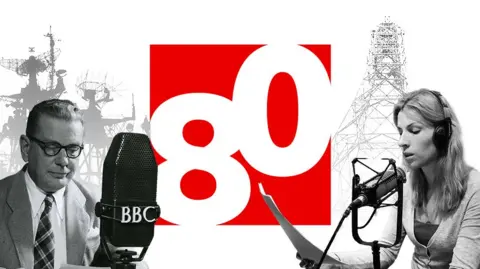
BBC Russian has been a beacon of free speech for 80 years, overcoming significant challenges from the Kremlin, including jamming broadcasts and blocking websites. This article highlights the historical significance of BBC Russian's efforts to provide an independent voice in Russia, the evolving nature of their operations, and the current battle against censorship and digital suppression as the service adapts to new restrictions.
The Kremlin is tightening its grip over what Russians can do and see online, making it harder for outlets like the BBC to reach their audiences.
For the past 80 years, BBC Russian has sought to bypass those restrictions, which for decades featured jamming of its short-wave radio broadcasts and now involve blocking its website.
The latest restrictions in Russia have included widespread mobile internet outages and a reported plan to block the Telegram news and messaging app.
On 24 March 1946, the BBC started its first regular radio broadcast in the Russian language aiming to give listeners behind the Iron Curtain in the Soviet Union an alternative to state propaganda and a tightly controlled cultural scene.
By 1949, jamming of the signal was already the norm.
For almost half of the 20th Century, Soviet people had to jump through hoops to listen to foreign broadcasts, and for some, it was truly a sport, remembers Natalia Rubinstein, an ex-BBC presenter and former resident of Leningrad.
We really wanted to know what was being hidden from us, she says.
Rubinstein remembers how people who were fond of cross-country skiing – a popular pastime in winter in Russia – used to take their radios with them out of town, where there were fewer jammers.
I still have this picture before my eyes: a person leaning on a tree, with ski poles next to him, listening to the radio somehow nestled on their chest, she recalls.
Jamming of foreign broadcasts was pioneered by Nazi Germany during World War Two, using noise or signals from more powerful transmitters located closer to the listeners.
During the Cold War, the BBC would repeat its 90-minute Russian-language bulletin three times a week, so people could listen at least once.
It featured not only news but also Western rock music, extracts from banned literature, and even, briefly, quizzes.
Occasionally BBC Russian succeeded in outfoxing the jammers. In a notable event during 1982 after Soviet leader Leonid Brezhnev’s death, they managed to air a special program unexpectedly without interference.
The BBC's reporting often outpaced Russian state media, providing insights into significant events that Russians were not hearing at home, such as Nikita Khrushchev's removal in 1964.
Following the Soviet era, and amid liberal reforms under Mikhail Gorbachev, BBC Russian began receiving direct feedback from its audience for the first time, prompting greater engagement.
However, the modern landscape has changed again, particularly with the onset of the Ukraine conflict. Following the invasion in February 2022, BBC News Russian experienced a surge in audience size reaching over 10 million people.
On 4 March 2022, the BBC's website, along with those of other independent media, faced a complete block in Russia, restricted under new laws that made it illegal to call the invasion a 'war'.
As a result, local BBC Russian staff were forced to leave the country to continue their reporting, establishing a new office in Riga, Latvia, amidst rising tensions.
This situation reflects a broader struggle within journalism in Russia, where the BBC and its staff confront significant risks, including being labeled 'foreign agents', recalling Soviet-era tactics against dissenting voices.
Despite these challenges, Jenny Norton, head of BBC News Russian, asserts that their commitment to provide accurate reporting remains critical. Today's audience relies heavily on alternative means, such as VPNs, to access independent journalism that is increasingly stifled by the Kremlin.
The ongoing battle for free speech showcases the unyielding determination of both the BBC Russian service and its listeners, who continue to find ways to access information amidst restrictive measures.