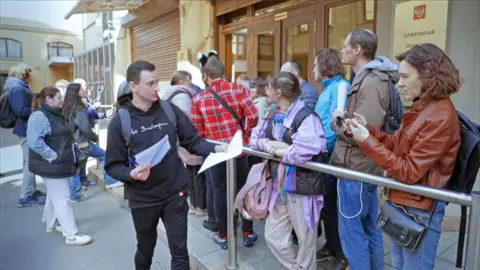
Near the Kremlin, several dozen people are queuing outside the presidential administration office. They’ve come to submit petitions calling on President Vladimir Putin to end a crackdown on the internet. Russian authorities have been tightening control of the country’s cyber space, restricting access to global messaging apps, resulting in widespread disruptions and even shutdowns of mobile internet.
Petitioning the president is legal, yet the authoritarian nature of the state makes this act hazardous. Witnesses report that security officers film the petitioners as they take a stand, highlighting the persistent atmosphere of fear. One individual, Yulia, expressed her fear, admitting, Very scared; I'm shaking.”
Putin has acknowledged the disruptions as necessary for “operational work to prevent terrorist attacks,” but maintains that essential services should operate uninterrupted. However, many in the public feel the internet restrictions have hindered their daily lives, particularly business owners like Yulia, whose catering company relies heavily on online access for operations.
In efforts to foster a “sovereign internet,” the Russian government is promoting a state-backed messaging app, MAX, although public skepticism is rife regarding its potential usage for surveillance. The authorities have heavily restricted access to apps like WhatsApp and Telegram, exacerbating concerns among the populace.
As internet cursorily disappears under the guise of regulation, certain areas now only permit access to government-approved sites, suggesting a digital divide intended to isolate Russia from the global community. Columnist Andrei Kolesnikov warns that the restrictions create a digital ‘Iron Curtain,’ reflecting a deeper rift as aggressive censorship expands.
Citizens recount immediate impacts on daily tasks, including payments and communication, creating a palpable frustration among those who have integrated digital processes into their lives. As Yulia notes, these restrictions create a sense of regress and uncertainty that permeates their future, echoing the sentiments shared by many Russians as they adapt to these challenging dynamics.
The Kremlin's push toward tighter internet control aligns with deeper economic concerns and escalating public fatigue with ongoing war efforts, echoing the sentiment among citizens that government restrictions are increasingly disconnected from daily realities. Activists warn of growing discontent among the populace, fanned by their frustration with the creeping repression manifesting in everyday life.