In brief
In a remarkable dive recovery operation, artefacts from HMHS Britannic, sunk during World War I, have been retrieved by a team of divers. The operation, organized by historian Simon Mills, recovered notable items including the ship's lookout bell and porcelain washbasins, which will be conserved and displayed in Athens.
Greece has announced the recovery of artefacts from the wreck of HMHS Britannic, more than a century after the Titanic's sister ship was sunk in wartime in the Aegean Sea by a German mine.
The operation was carried out in May but only made public on Monday, when the culture ministry released details of the finds.
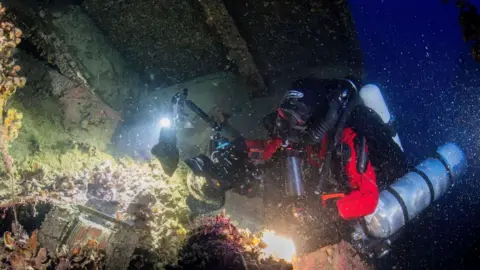
An 11-member team of professional deep-sea divers with closed-circuit equipment conducted the recovery, organised by British historian Simon Mills, founder of the Britannic Foundation.
Among items retrieved and lifted with air bags were the ship's lookout bell, a portside navigation lamp, binoculars, ceramic tiles from Turkish baths, and equipment from first- and second-class cabins.
The artefacts were secured in containers and immediately cleaned of marine organisms. They were then transferred to the laboratories of the Ephorate of Underwater Antiquities in Athens, where conservation work will continue.
Some objects identified in the original plan could not be recovered because of their condition and location. Artefacts will eventually go on display at the new National Museum of Underwater Antiquities in Piraeus, in a section dedicated to World War One.
The Britannic was the third of the White Star Line company's Olympic class of steamships, along with the RMS Titanic and RMS Olympic. The vessel was requisitioned by the British Admiralty during the war to serve as a hospital ship.
On 16 November 1916, it struck a German mine off the island of Kea and sank in less than an hour. Of the 1,065 people on board, 30 died when two lifeboats were pulled into the ship's propellers.