In brief
Groundbreaking analysis of lunar samples uncovers volcanic rocks dating back over 4.2 billion years, highlighting the geological complexity of the Moon's far side.
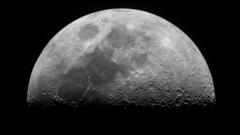
Researchers from the US and China have made a significant breakthrough by uncovering traces of ancient volcanic activity on the far side of the Moon, providing new insights into the Moon's geological history. The team analyzed samples brought back by the Chinese Chang’e-6 mission, which retrieved fragments of basaltic rock that date back over 4.2 billion years. Their findings were published in prestigious journals such as Nature and Science.While the near side of the Moon has long been known to exhibit volcanic features, the far side presents a drastically different geological landscape that has remained largely unexplored until now. The analysis revealed that the basalt fragments not only pointed to ancient eruptions but also indicated a remarkably recent volcanic event approximately 2.83 billion years ago—an eruption not previously recorded on the Moon's near side.Professor Qiuli Li, from the Institute of Geology and Geophysics, expressed enthusiasm for the study, labeling it as a pivotal contribution to the fields of lunar and planetary science. He highlighted the importance of this research as the first geochronology study derived from the Chang’e-6 samples.Colloquially referred to as the "dark side," this part of the Moon receives abundant sunlight and is consistently facing away from Earth due to the Moon's tidal locking. Since the first image of the Moon's far side was captured by the Soviet Luna 3 spacecraft in 1959, advancements in imaging technology—including a recent NASA video—have revealed more about this enigmatic terrain.Moreover, as part of the Chang’e-6 mission, a rover successfully took a selfie on the far side, further adding to our understanding of this region. As lunar exploration continues, these findings shed light on how volcanic activity has shaped not only the Moon's surface but also potentially our understanding of planetary processes as a whole.