In brief
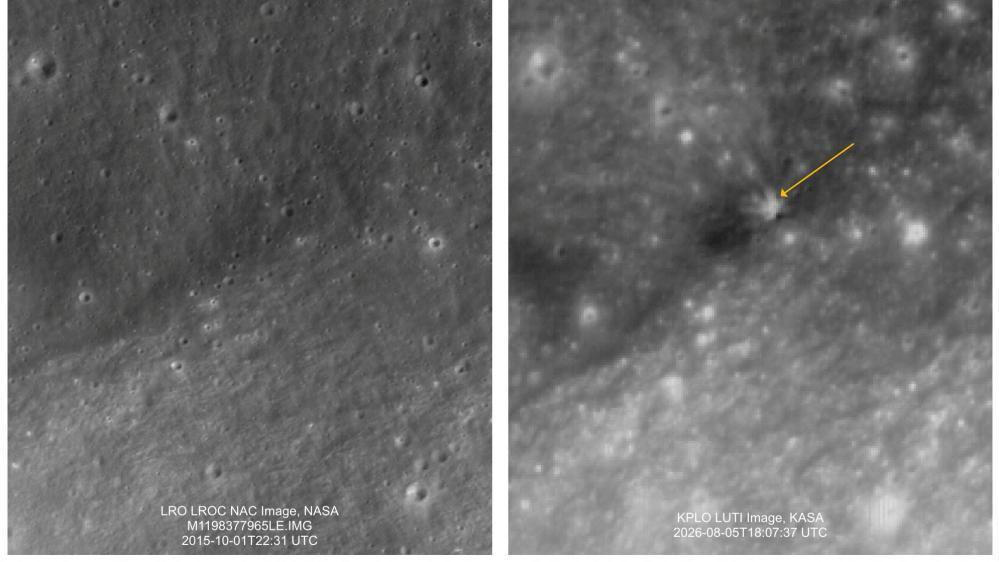
South Korea’s Korean AeroSpace Administration (KASA) released a series of images showing the Moon’s surface before and after a SpaceX Falcon 9 upper‑stage fragment fell in 06:35 GMT on Wednesday. The impact, unintentional according to SpaceX, was captured by KASA’s Danubri orbiter and shared via X along with comparative photos. The fragment—about the size of a five‑storey building and weighing 4,000 kg—had travelled in a looping orbit around Earth, Moon, and Sun before its eventual collision. While the Moon’s gravity absorbed the impact with minimal hazard to Earth, climatologist Matt Bothwell raised concerns about the rapid growth of orbital debris and its implications for future missions. The incident underscores the need for stronger debris‑control measures as reusable rockets become more common.
South Korea's KASA has posted images of the Moon's surface following an accidental SpaceX rocket fragment impact, ca. 06:35 GMT.
The photos were taken by the Danubri lunar orbiter and posted on X. They juxtapose the lunar landscape before the crash with the new impact site, providing the first visual evidence that the second stage of a Falcon 9 rocket—measuring roughly 70 m tall—has struck the Moon.
SpaceX confirmed the event was unintentional and noted that “the upper stage was not designed to collide with the lunar surface.” The fragment, weighing about 4,000 kg on Earth, was guided into a looping orbit around Earth and the Moon before it entered Luna’s gravitational field.
While the Moon absorbed the impact harmlessly and no Earth‑bound debris resulted, astronomers warn that such incidents highlight the mounting clutter in space. “Space is getting more crowded,” said leading astrophysicist Matt Bothwell, who cautions that a dense environment could hinder future deep‑space missions.
This incident follows increasing use of reusable rockets. For every mission, the upper stage may drift for months before an eventual miss or, as here, a collision with a celestial body. These events raise a call for stricter debris‑free operations and clearer guidelines for post‑flight disposal.
KASA’s rapid imagery release offers scientists a unique dataset to analyze impact mechanics on the lunar regolith. More detailed studies may also refine models of how orbital decays affect long‑term space logistics.
Source: BBC News, 6 August 2026