In brief
At ADIPEC 2026, Abu Dhabi’s Department of Energy and partners signed an agreement to develop liquefied natural gas solutions for industrial and commercial facilities not served by current gas networks. The deal could unlock up to AED 1 billion in investment and aligns with the emirate’s energy security and sustainability goals. The partnership aims to diversify supply, improve reliability, and facilitate a shift to lower‑emission fuels.
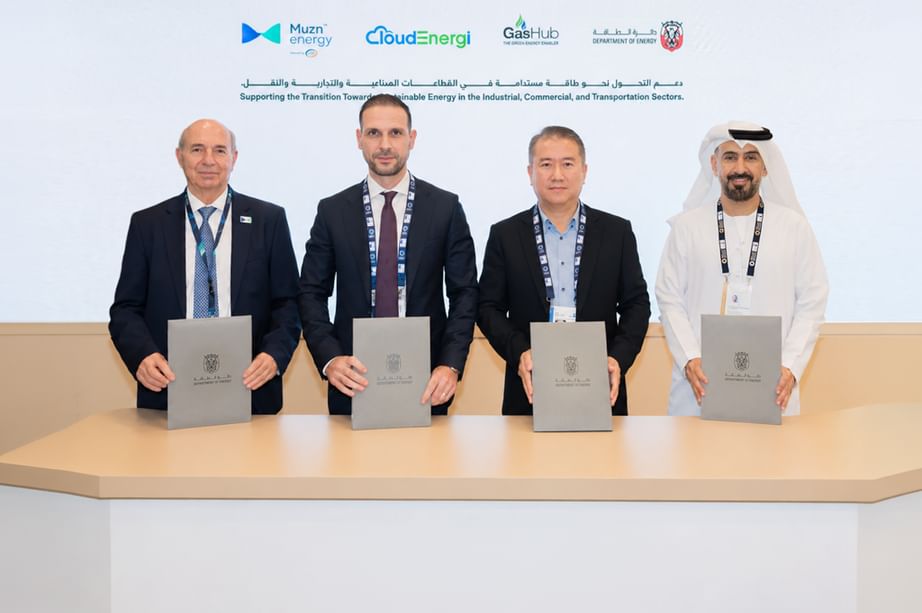
Abu Dhabi’s Department of Energy (DoE) signed a cooperation framework at the Abu Dhabi International Petroleum Exhibition and Conference (ADIPEC 2026) that could see up to AED 1 billion invested to supply liquefied natural gas (LNG) to industrial and commercial facilities that lie beyond the reach of the emirate’s existing gas distribution system. The agreement brings together the DoE’s H2G Green Ltd and its subsidiary GasHubUnited Utility Private Ltd, MUZN Energy – a subsidiary of SERGAS Group – and Cloud Energi gas company.
LNG as a bridge to industrial sustainability
The partnership focuses on assessing the feasibility of local LNG production, transportation, and distribution to meet the needs of facilities that currently lack direct gas links. By offering a flexible and reliable supply alternative, LNG could help these companies maintain continuous operations while they transition from high‑emission fuels. The agreement is part of Abu Dhabi’s broader strategy to enhance energy security and improve the efficiency of its energy system.
Under the framework, the parties will explore how LNG can be made available to key industrial and commercial sites. A central objective is to diversify supply options and reduce dependence on a single project or network, thereby strengthening resilience for sectors critical to the emirate’s economic growth.
DoE officials highlighted that the collaboration would draw on private‑sector expertise and an enabling regulatory environment to attract investment and spur innovation. The combined expertise of the partners is expected to identify practical solutions that integrate with existing infrastructure, while opening pathways for businesses to adopt lower‑emission alternatives.
The potential investment of up to AED 1 billion is earmarked for developing flexible LNG supply solutions over the coming years. This capital could fund the construction of infrastructure, the procurement of LNG carriers, or the establishment of distribution networks that serve sites currently outside the coverage of traditional pipelines.
GF&G Green and GasHubUnited, both with experience in LNG operations, will likely lead the assessment of opportunities for local production. Meanwhile, MUZN Energy’s background in gas projects and Cloud Energi’s focus on gas transport are expected to enrich discussions on how best to deliver LNG to the target facilities.
While the announcement did not provide detailed timelines, the DoE stated that the cooperation framework would examine solutions for facilities that are “located beyond the coverage of existing gas distribution networks.” Addressing these gaps aligns with the emirate’s ambition to support a robust and sustainable energy mix.
Abu Dhabi’s commitment to sustainable economic development is evident in the agreement’s focus on low‑emission fuels. By diversifying supply and exploring LNG as an alternative to conventionally sourced natural gas, the city aims to reduce the overall carbon footprint of its industrial sector.
Experts in the field see LNG as a transitional fuel that could bridge the gap between fossil fuels and a fully renewable future. The ability to liquefy natural gas for transport and storage also offers an advantage for sites lacking pipeline access, making it a practical short‑ to medium‑term solution.
In line with these goals, the DoE’s partnership with private sector players underscores a collaborative approach to innovation. By combining public oversight with commercial delivery capabilities, the project intends to create a scalable model that could be replicated in other regions of the Gulf.
Environmental groups that advocate for a rapid decarbonization of industry expressed cautious optimism. While they acknowledged the potential reliability benefits, they urged that any LNG expansion be conducted alongside parallel investment in renewable energy and carbon‑capture technologies.
The agreement also hints at future extensions to support maritime operations, though the details remain under assessment. Should maritime cooperation materialize, it could open a new channel for LNG to supply shipping lanes or offshore facilities.
As Abu Dhabi positions itself as a regional energy hub, the DoE’s focus on LNG infrastructure reflects a broader trend of leveraging flexible gas solutions to meet industrial demand while maintaining price stability and supply continuity. The proposed investment is poised to enhance the emirate’s resilience, drive economic growth, and advance its sustainability agenda.
Stakeholders will closely monitor the progress of the partnership’s pilot projects and the pace at which investment flows are realized. Given the complexity of LNG supply chains, the forthcoming assessment will be critical to ensuring the feasibility and environmental impact of the proposed solutions.