In brief
Yoweri Museveni's latest election victory marks his seventh term as Uganda's president. Despite continued support, dissent from opposition leader Bobi Wine and concerns over Museveni's health and the legitimacy of the elections highlight uncertainties in Uganda's political future. Observers are now questioning the succession dynamics within Museveni's regime, as the influence of his son, Gen Muhoozi Kainerugaba, grows amidst allegations of state repression against opposition forces.
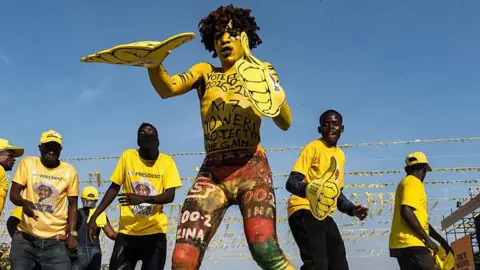
For supporters of Uganda's President Yoweri Museveni, his resounding victory in the just-concluded election is a vindication of his 40-year-long rule.
He won with 72% of the vote, close to his highest-ever tally of 74% in Uganda's first direct presidential election in 1996.
This reinforces the 81-year-old's claim to still command the support of the overwhelming majority of Ugandans, after seizing power as a rebel commander in 1986, ending the rule of the Milton Obote regime.
But Museveni's main election rival, the charismatic former pop star Bobi Wine, dismissed the result as fake and said he had gone into hiding following a raid on his home by the security forces.
Museveni campaigned largely on his track record, arguing that he has delivered political and economic stability in an era of global uncertainty.
He pledged to steer Uganda towards achieving the status of a middle-income country by 2030, which his supporters have framed as a fitting legacy for a man who will finish his seventh - and possibly final - term the following year.
Museveni views Uganda's nascent oil industry as central to this goal, often telling voters that once exports commence, the economy would grow at double-digit rates. He has set October as the target date for the first crude oil exports via a 1,443 km pipeline to the Indian Ocean port of Tanga in Tanzania.
Despite his age, the president has sought to project vitality and control. At one of his final campaign rallies, he stated that he had visited all of Uganda's more than 140 electoral constituencies. However, his campaign schedule has seen abrupt cancellations lately for state duties, heightening speculation about his health.
For Wine, the election was a significant disappointment as his vote share dropped from 35% in 2021 to 25%. He claims the campaign was neither free nor fair, citing disruptions by security forces and alleging electoral fraud, though he has not yet provided concrete evidence to support his claims.
The dynamics of Uganda's political future are increasingly focused on questions of succession as Museveni's influence wanes. Insights from political analysts suggest that while the recent election may seem a significant event, it is indicative of deeper shifts within Museveni's regime and ongoing debates surrounding the military's role in governance.
As the nation approaches a critical transition, the power dynamics predominantly shaped by Museveni's lineage, particularly involving his son, Gen Muhoozi Kainerugaba, will likely influence Uganda's political landscape for years to come.