The UK government has detailed for the first time how it aims to fulfil its manifesto pledge to work toward phasing out animal testing.
The new plans include replacing animal testing for some major safety tests by the end of this year and cutting the use of dogs and non-human primates in tests for human medicines by at least 35% by 2030.
The Labour Party stated in its manifesto that it would partner with scientists, industry, and civil society as we work towards the phasing out of animal testing.
Science Minister Lord Vallance told BBC News that he could imagine a day where the use of animals in science was almost completely phased out but acknowledged that it would take time.
Animal experiments in the UK peaked at 4.14 million in 2015, primarily due to a rise in genetic modification experiments involving mice and fish. By 2020, the number had dropped to 2.88 million as alternative methods developed, though that decline has plateaued. Lord Vallance emphasized the need to reignite the downward trend by moving towards experiments on animal tissues grown from stem cells, AI, and computer simulations.
The government's new plans entail phasing out animal testing for some major safety tests by the end of 2025, switching to lab methods using human cells instead.
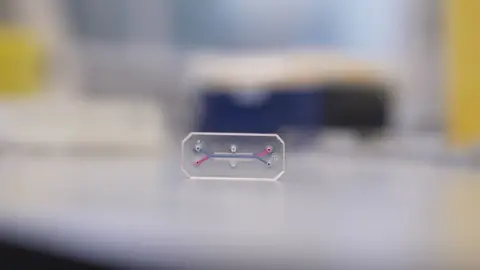
Research efforts include the development of organ-on-a-chip technologies that mimic human organs' functions using samples of human cells, thus reducing the need for animal testing.
However, experts in the field express varying opinions on the feasibility of reaching 'near zero' animal testing, with some asserting that certain complexities of biological systems cannot be adequately replicated without using live subjects. As such, the approach moving forward will require careful validation and additional funding for innovative alternatives.