Warning: This article contains graphic descriptions of death and injury.
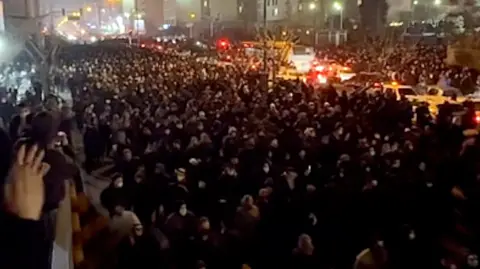
Heading home after joining a protest in Tehran on 8 January, Reza put his arms around his wife Maryam to protect her. Suddenly, I felt my arm go light – there was only her jacket in my hands, he told a family member, who later spoke to BBC Persian. Maryam had been fatally shot - and they had no idea where the bullet had come from.
Reza carried Maryam's body for an hour and a half. Exhausted, he sat down in an alley. After a short time, the door of a nearby house opened. The people who lived there took them into their garage, brought a white sheet and wrapped Maryam's body in it.
Days before Maryam headed out to the protests, she had told her children - aged seven and 14 – about what was happening in their country. Sometimes parents go to the protests and don't come back, she said. My blood, and yours, is no more precious than anyone else's.
Reza and Maryam's names have been changed for safety reasons.
Maryam is one of thousands of protesters who should have returned home but never did, as the authorities responded to the rapid spread of demonstrations across Iran with a deadly crackdown.
The US-based Iranian Human Rights Activists News Agency (HRANA) says it has been able to confirm the killing of at least 2,400 protesters, including 12 children, during the past three weeks.
It is extremely difficult to determine the death toll, which is expected to rise in the coming days, because the country remains under a near-total internet blackout imposed by Iranian authorities on Thursday night.
Human-rights groups have no direct access to the country and, along with other international news organisations, the BBC is unable to report on the ground.
Iranian authorities have not provided a death toll but local media have reported 100 security personnel have been killed, and protesters - whom they have portrayed as rioters and terrorists - have set fire to dozens of mosques and banks in various cities.
The protests began in the capital, Tehran, on 29 December, following a sharp fall in the value of the Iranian currency against the dollar. As the protests reached dozens of other towns and cities, they turned against Iran's clerical rulers.
Security forces soon launched a violent crackdown, with at least 34 protesters reported killed by 7 January, the 11th day of the unrest. However, the bloodiest crackdown occurred last Thursday and Friday, when thousands of people took to the streets across the country and called for an end to the rule of the Supreme Leader, Ayatollah Ali Khamenei.
Witnesses told BBC Persian that the authorities used excessive force, citing instances where security forces shot predominantly at heads and faces.
In Tonekabon, a town of 50,000 people in the north, 18-year-old university student Sorena Golgun was reportedly shot in the heart while fleeing security forces. The accounts reflect a broader landscape of deadly violence throughout the country, including in less populated areas.
For many, including young and aspiring individuals like Sorena and Robina Aminian, a 23-year-old fashion-design student, dreams were cut short by violence. Robina was shot dead in Tehran, and her family was forced to bury her body in a remote cemetery with no one present.
As the protests continue and the government's crackdown intensifies, many Iranians express fear for the future. One young woman, who fled the country following the recent unrest, described the events as resembling a war, voicing concern for those left behind in Iran.
This ongoing situation raises urgent questions about human rights and the safety of civilians in the face of oppressive governance.