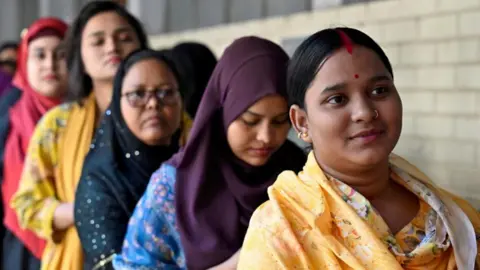
Votes are being counted in Bangladesh after its first election since student-led protests ousted Prime Minister Sheikh Hasina in 2024.
More than 2,000 candidates are vying for 300 elected seats in parliament, though none from the banned Awami League of Hasina, who fled after 15 years in power following a brutal security crackdown.
The election pits the centre-right Bangladesh Nationalist Party (BNP) against a coalition led by the Islamist Jamaat-e-Islami, which joined forces with a party born out of the student uprising.
Results are expected on Friday, raising widespread hopes among voters for a return to democracy.
For the first time since 2008, the outcome of this election cannot be predicted with certainty.
Sheikh Hasina has been convicted and sentenced to death in absentia for her role in a crackdown that resulted in as many as 1,400 protesters being killed.
Hasina, now in exile in India, has rejected the charges against her and questioned the legitimacy of the election process.
The ban on her Awami League contesting the polls casts a shadow over the election's fairness, but many voters have expressed feeling they finally have a genuine choice.
With more than 120 million people eligible to vote, about 40% of them under 37, the election also includes a referendum on proposed constitutional changes by the interim government.
Interim leader Muhammad Yunus stated that the country has ended the nightmare and begun a new dream.
Turnout had reached 49% by 14:00 local time, with nearly a million police and soldiers deployed to maintain order.
Leading candidates include Tarique Rahman for the BNP and Shafiqur Rahman representing Jamaat. Both parties have a history of rivalry and alliance, and Jamaat's participation marks a new chapter in Bangladeshi politics.
Despite the hopeful atmosphere, concerns remain regarding women's representation in the political sphere, as both parties field limited female candidates.
This election stands as a crucial turning point for Bangladesh's democratic aspirations, as voters await the outcome with the hopes of embracing a new governance era.