In brief
Launched in 2005, India's National Rural Employment Guarantee Scheme provides rural households the right to demand paid work. Recent developments, including a name change and changes in funding structure, have raised concerns among experts and opposition groups about potential dilution of this crucial employment guarantee. As rural livelihoods continue to depend on the program, the future of this transformative social initiative hangs in the balance.
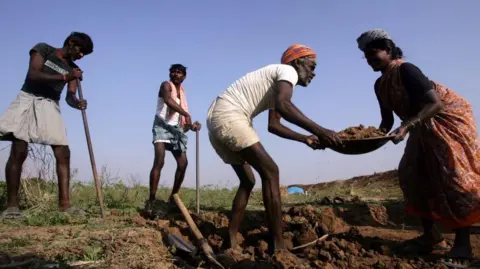
India is home to one of the world's most ambitious social programmes - a jobs guarantee that gives every rural household the legal right to paid work.
Launched in 2005, by a Congress party government, the National Rural Employment Guarantee Scheme (NREGS) allows every rural household to demand up to 100 days of paid manual work each year at a minimum wage.
This initiative is particularly significant in India, where 65% of 1.4 billion people live in rural areas and nearly half rely on agriculture, which provides insufficient income — accounting for only 16% of the country’s GDP.
The scheme has become a foundation for rural livelihoods, particularly evident during economic downturns. It is renowned as one of the most effective anti-poverty programmes, boasting gender equity, with over half of its estimated 126 million workers being women, and around 40% from marginalized communities.
The government led by Narendra Modi, initially skeptical, has turned to this programme during crises — most notably the COVID-19 pandemic — when demands soared as millions returned to rural areas from cities. Economists note that it helped raise rural consumption, reduce poverty, and improve school attendance.
Recently, however, the government has introduced a new law that overhauls the NREGS, renaming it G RAM G, dropping the iconic name of Mahatma Gandhi altogether.
While the new legislation boosts the employment guarantee from 100 to 125 days, it also redefines funding: previously, the central government covered 90% of wages and costs. The latest reform proposes a 60:40 split of costs between central and state governments, transferring more budget responsibility to states.
Critics argue that this shift may erode the scheme's core benefits, turning a legal guarantee into a discretionary measure reliant on fiscal capacity. Jean Dreze, a development economist, warned that while the increase in workdays looks beneficial, it fails to address underlying operational challenges — only 7% of rural households received the full 100 days of work in 2023-24.
International experts have weighed in, expressing concerns that dismantling the original framework could jeopardize its substantial achievements in poverty alleviation and rural empowerment.
Despite ongoing challenges — including chronic underfunding and administrative inefficiencies — the jobs guarantee scheme remains critical. Its ability to adapt will determine whether it can continue to support millions of workers who depend on it, encapsulating a broader issue: India's struggle to generate sufficient non-farm jobs for its vast rural population.