In brief
In the heart of Tehran, citizens navigate a landscape marked by economic hardship and the looming reality of war. Local shopkeepers express their dwindling customer base as national strife continues to impact livelihoods. Despite their challenges, the resilient spirit of the people shines through, embodying an everyday hope for stability as they confront uncertain futures.
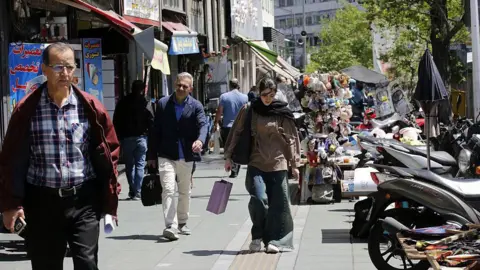
On a bright Tehran spring day, Sanaei Ghaznavi street, with its mix of shops selling groceries and household goods alongside fast food and flowers, seems like an everyday place.
In a country where lives have long been buffeted by crises, it is a snapshot of a people just trying to get through the day while their future hangs on forces beyond their control.
For Mohammad, in t-shirt and jeans, even cranking open the striped awning of his family's shoe shop is an act of hope.
It makes me happy to be in here, he tells us when we wander into his pocket of a store with its floor-to-ceiling shelves of trainers, big and small. So many people have lost their jobs and aren't working. And there are few customers.
We had so many before, his father Mustafa laments glumly as he proudly explains this business has been in their family for 40 years.
One Iranian website, Asr-e Iran, recently cited an unofficial estimate that up to four million jobs may have been lost or impacted by the combined effect of the war and the government's near-total internet shutdown.
Boxes labelled with western logos like New Balance and Clarks protrude from this shop's packed shelves. Made in China, both father and son note matter-of-factly. Even fakes are expensive in Iran, Mohammad adds.
We hope the war starts again, Mohammad declares, breaking into a wry smile. His father eyes knowingly his 27-year-old son. Look at my grey hair, I understand more than him. We're just tired of living with an economy which keeps getting worse, Mustafa says. Some people believe that, if war returns, things will eventually improve dramatically.
Outside the nearby corner shop, Shahla, an elderly woman wearing a pale headscarf balances a loaf of bread on a clipboard securing her shopping list and a wadge of bills. She stops in her tracks when she sees us walking by and offers her thoughts.
People are paying three times more for a loaf of bread now, she moans, her fingers resting on the soft white slices inside the plastic. People are going through hell now just to pay for bread. She casts her eyes across this leafy street in central Tehran, which sits midway between the affluent north with its glittering shops and chic cafes, and the poorer, more conservative south.
People who are well off, they're okay, but not for workers who don't earn much, Shahla spells out.
As she makes haste to finish her shopping, a young man wanders past clutching a small glass bottle of a green spread. It's valak butter, he says, using the Persian word for wild garlic, which thrives in the foothills of the snow-capped Alborz mountains to the north. I made it myself.
Even Iran's communications minister has called for the ban on internet access to be lifted, highlighting that around 10 million people depend on digital connectivity for their work. Restrictions are slowly and selectively easing – although the message from security officials is they will stay in force as long as enemy threats remain.
Security has visibly tightened. We feel it on this street too, as plain-clothed security from the paramilitary volunteer Basij or the Islamic Revolutionary Guards becomes commonplace. Contrary to earlier hopes, the shadow of war now looms larger than the aspirations for normalcy that once filled these bustling streets.