In brief
Autonomous delivery bots promise greener, quicker service. Yet they pose new risks to pedestrians, raise job‑cutting fears, and expose policy gaps. Cities are tinkering with bans, permits and public campaigns amid a global shift toward robot delivery.
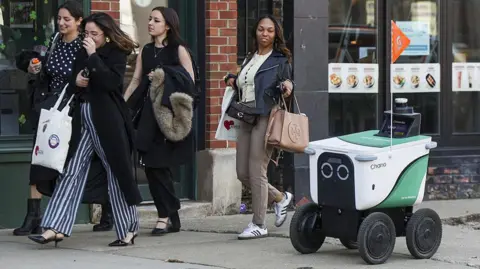
In Chicago a resident named John Roberts found one of the first delivery bots creeping down his street and was intrigued by the sleek design. He called it “neat” and “futuristic.”
The excitement faded after the robot collided with pedestrians on a family stroll, forcing people to duck out of the way very close to a road. Roberts noted the danger of having autonomous vehicles share single‑story pathways with walkers.
These robots, first appearing in cities like London, Tokyo and Seoul, carry groceries or fast food in small cabinets. They use cameras, sensors and GPS to navigate around obstacles, but require operating rules to protect the public.
City officials have responded in a variety of ways. San Francisco limited robot access to quieter streets, Toronto banned sidewalk use for them, and Chicago recently outlawed them in two neighbourhoods after residents protested the lack of safety tests and permission procedures.
Roberts launched a petition demanding city‑wide suspension of all delivery bots until formal safety and access regulations are approved; the petition currently has over 4,400 signatures.
Beyond pedestrian risk, the trade union IWGB highlights potential job losses as autonomous systems replace human couriers in London and elsewhere. The union urges government regulators to scrutinize the shift to ensure protection for precarious workers.
Despite controversies, analysts predict a substantial expansion. One report estimates 2.1 million autonomous delivery robots circulating globally by 2034, a figure that underscores the competitive momentum behind the technology.
Stakeholders now face an important dilemma: whether the promise — reduced traffic, lower emissions, faster delivery — can outweigh the unresolved human‑centric concerns. As technology moves forward, careful policy design and public engagement will be essential for a sustainable future.
Source: BBC News – “We had to get out of the way”: The backlash over delivery robots. © 2026 BBC.