Myanmar has denied committing genocide against the Rohingya people, stating that The Gambia has not provided sufficient proof as it begins its defense at the UN's top court.
Ko Ko Hlaing, a Myanmar government representative, declared the allegations to be unsubstantiated before judges at the International Court of Justice (ICJ).
Earlier, The Gambia's foreign minister Dawda Jallow accused Myanmar of attempting to erase the minority Muslim population through genocide.
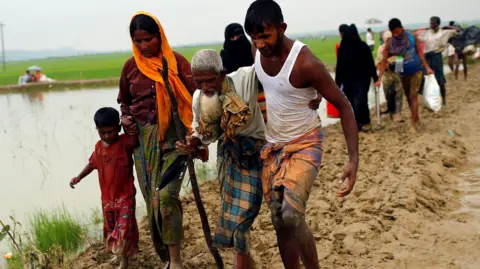
During a brutal military crackdown in 2017, thousands of Rohingya were killed, forcing more than 700,000 to flee to neighboring Bangladesh.
A damning UN report from the following year recommended investigation of Myanmar's top military officials for genocide and crimes against humanity. However, Myanmar dismissed the report, maintaining that its military operations targeted insurgent threats.
Hlaing told the ICJ that Myanmar could not remain passive while terrorists operated in northern Rakhine state, home to most Rohingya. He described the military’s actions as necessary counter-insurgency measures.
The Gambia filed the lawsuit in 2019 out of a sense of responsibility, advocating for the Rohingya, who it claims have faced decades of persecution and dehumanizing propaganda.
Legal representatives for The Gambia argued that the systematic killing of civilians and destruction of villages cannot be justified as counter-terrorism. Philippe Sands, representing The Gambia, urged the court to conclude that a genocidal intent underpinned Myanmar's actions against the Rohingya.
More than a million Rohingya currently reside in refugee camps in Bangladesh's Cox's Bazar area, with Hlaing asserting Myanmar's commitment to repatriate those in Bangladesh, despite challenges like COVID-19.
Hlaing stressed that a finding of genocide would tarnish Myanmar and emphasized the importance of the case for the country's reputation. The court's ruling, expected in 2026, could establish important precedents for future genocide cases, including one recently brought by South Africa against Israel regarding the Gaza conflict.
The 1948 UN Genocide Convention, which The Gambia cites as violated by Myanmar, defines genocide as actions intended to destroy, wholly or partially, a national, ethnic, racial, or religious group.