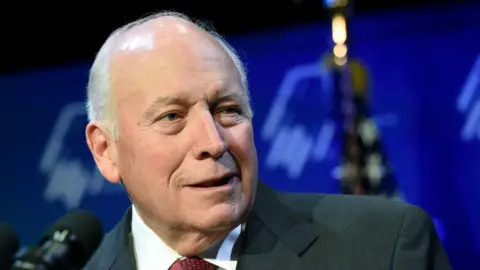
Former US Vice-President Dick Cheney, a key architect of George W. Bush's war on terror and an early advocate of the invasion of Iraq in 2003, has died at the age of 84.
He died from complications of pneumonia and cardiac and vascular disease on Monday night, his family said.
Cheney served as Gerald Ford's White House chief of staff in the 1970s, before later becoming one of the most powerful US vice presidents in history under Bush.
In his later years, he became a bitter critic of the Republican Party under the leadership of Donald Trump.
Cheney's family stated, Dick Cheney was a great and good man who taught his children and grandchildren to love our country, and to live lives of courage, honour, love, kindness, and fly fishing.
Cheney was born in Lincoln, Nebraska in 1941 and attended Yale University on a scholarship but did not graduate. He gained a Master's degree in political science from the University of Wyoming.
His political career started in 1968 with a role for Republican representative William Steiger. He became chief of staff under Ford at just 34 and later spent a decade in the House of Representatives.
As Secretary of Defense under George H.W. Bush, he oversaw the Pentagon during the Gulf War, leading to Iraq's eviction from Kuwait. Then, as Vice President, he played a significant role in post-9/11 U.S. foreign policy, primarily the invasions of Afghanistan and Iraq. Cheney became a controversial figure, noted for his claims about Saddam Hussein's alleged weapons of mass destruction.
His legacy is marred by the prolonged conflict in Iraq, which led to significant loss of life. Late in his life, Cheney became a critic of Trump and supported his daughter Liz's opposition to him, reflecting his complicated relationship with the political landscape he once helped define. His passing marks the end of an influential yet divisive chapter in U.S. political history.