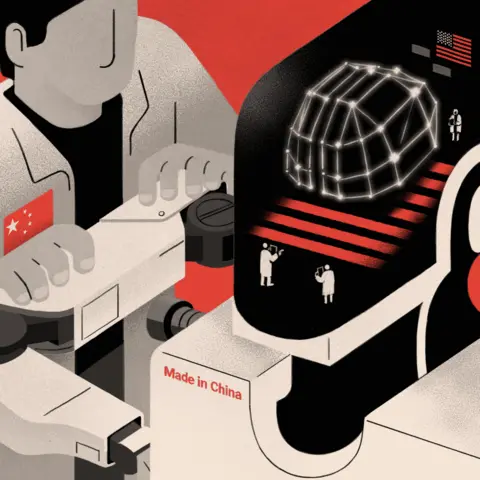
In the second half of the 20th Century, it was the race to develop nuclear arms that occupied some of the finest minds in the US and the Soviet Union.
Now the US finds itself in a different kind of race with a different adversary: China. The aim is to dominate technology; specifically Artificial Intelligence (AI).
It's a fight taking place in research labs, on university campuses, and in the offices of cutting-edge start-ups - watched over by leaders of some of the world's richest companies, and at the highest levels of government. It costs trillions of US dollars.
Each side has its strengths: Nick Wright from University College London describes it as the battle between brains and bodies. The US traditionally leads on AI brains—chatbots and large language models (LLMs)—while China excels in AI bodies, particularly humanoid robots.
The release of ChatGPT by OpenAI on November 30, 2022, marked a significant milestone, showcasing the US’s lead in LLM technology. Now, over 900 million people utilize ChatGPT weekly, prompting other firms like Google and Anthropic to invest heavily in AI.
However, Washington remains concerned about the implications of this technological race for global supremacy. Most high-end computer chips are designed and controlled by American companies like Nvidia. Stricter export controls have hindered China's access to these chips, preserving US advantages in AI development.
In response, China has begun to innovate independently, launching its own AI chatbot, DeepSeek, estimated to have been developed at a fraction of the cost of American models like ChatGPT. This has triggered significant market reactions, including Nvidia suffering massive losses.
Beyond software, China holds a substantial lead in robotics, with over two million working robots. This manufacturing might allows for rapid automation and innovation in AI bodies.
Despite China's advancements, American strength in AI 'brains' persists, largely influenced by proprietary technology. Both nations are now racing to combine robots with more intelligent, agentic AI systems.
Ultimately, the victor of this race will not just be defined by who is first but by who effectively integrates AI across their economies and sets global standards. The stakes of this competition are monumental, likely influencing the balance of power in the 21st century.