In brief
Massive peatland fires in Indonesia’s Borneo island have scorched 1.9 million hectares of forest and flooded neighbouring countries with toxic smoke. Residents in Central Kalimantan are forced to stay home, as everyday life turns into an indoor survival game. The haze has racked the city with over 277,000 coughs and pneumonia cases, including 62,000 children under five. While authorities deploy firefighters and experimental weather‑muddling, the lack of water and fresh air keeps the crisis growing. Local voices describe a desperate, yet hopeful, fight for survival amid a symphony of coughing, faces with masks and the heavy drag of an impending rainstorm.
When sunrise turns the sky rust‑orange and the streets vanish behind a hazy veil, Palangkaraya transforms into a twilight city of dim silhouettes.
In the quiet of night, mother‑of‑three Dianyra Eka Nastiti clutches her infants, malaria‑scented air thick in lungs that have already seen a month‑and‑half‑old baby taken to hospital for bronchopneumonia.
Central Kalimantan has been scorched for weeks; satellite data from Nusantara Atlas show 1.9 million hectares—roughly the size of New Jersey—shrouded in fire. Yet the unseen threat is far greater: syngas, carbon monoxide and microscopic diesel‑size particles that seep deep into lungs and bloodstream, sparking inflammation and long‑term disease.
The Health Ministry reports more than 277,000 respiratory cases this year, over 62,000 of them infants. Young reporters the news underline the human toll with narratives of school‑children learning online because teachers fear coughing fits in public.
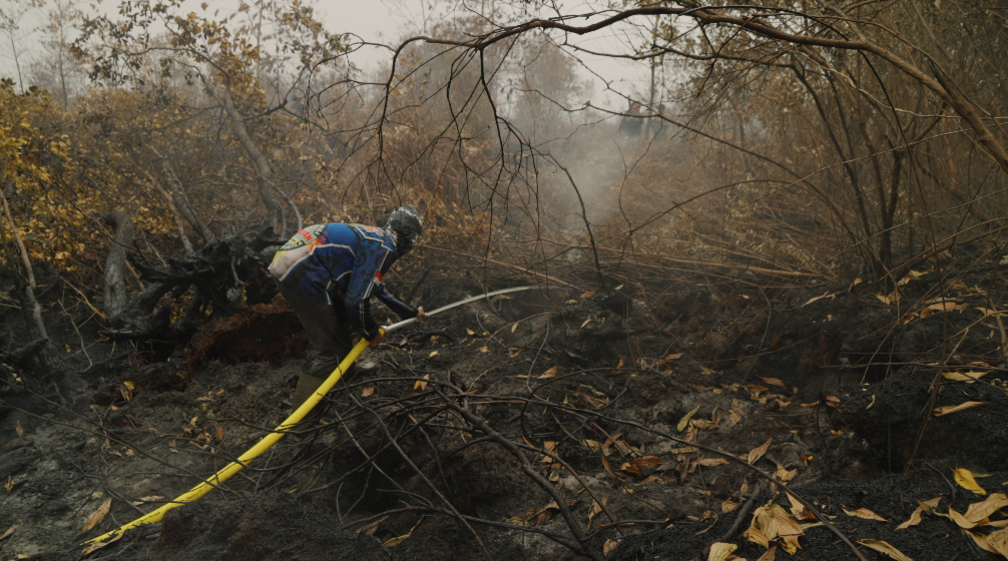
Firefighters like Juni and Fauzi face a nightmare scenario: peat fire requires water poured deep into layers of earth, a task becoming impossible as drought grabs hold of the region. Water volumes that once filled hectares are now fleeting, forcing the emergency crews to rely on aging planes and experimental cloud‑rain techniques.
Community leaders, such as Riduan, head of the local health office, call for a coordinated alliance among police, military and volunteers, hoping a storm will break the furnace of fire and pall. Meanwhile, residents are forced into indoor hives, masks, and makeshift air‑filters that do little against an invisible toxic cloud.
Despite heavy efforts, the haze remains a living, breathing crisis, leaving children’s voices quieter, streets hysterical, and hope sliding while a rain‑chasing prayer grows with each silent dawn.