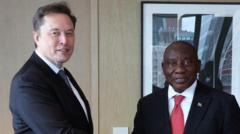
South Africa's President Cyril Ramaphosa has taken proactive steps to address a growing conflict with the U.S. government regarding the nation's new land reform laws. In a bid to clarify South Africa’s position, President Ramaphosa engaged directly with tech billionaire Elon Musk, who is an influential adviser to U.S. President Donald Trump.
The call came in response to Trump's criticism that South Africa was confiscating land and fostering a racially discriminatory environment. This controversy erupted after Ramaphosa recently signed legislation allowing for land seizures without compensation in specific situations deemed to be in the public interest. Musk voiced his discontent on social media, questioning the fairness of the ownership laws.
During their conversation, Ramaphosa reaffirmed the core values of South Africa's constitution, emphasizing the principles of justice, fairness, and respect for the law. He previously indicated that the South African government has not engaged in land confiscation. However, Trump's statements on his platform Truth Social escalated concerns, as he threatened to suspend U.S. funding until a thorough investigation of the situation occurs.
Land ownership in South Africa remains a divisive and sensitive issue, stemming from a long history of racial segregation and ownership disparities established during apartheid. Following the 1913 Natives Land Act that predominantly restricted land rights for the black majority, the landscape of land ownership has been significantly skewed, with a staggering 72% of private farmland still owned by white individuals as of 2017.
While the passage of this new law aims to rectify historical injustices, critics warn that misguided application of land seizures could echo the disastrous economic fallout seen in Zimbabwe after similar reforms. These tensions underscore the urgency for balanced discourse and equitable solutions that recognize the complexities of land ownership in post-apartheid South Africa.