In brief
In a touching tale of resilience and determination, blind athletes Rakshitha and Simran prove that with the right support, the sky is the limit.
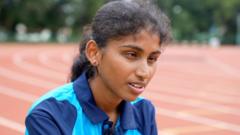
Rakshitha Raju, a 24-year-old para athlete from a small village in southern India, has transformed perceptions and broken barriers for visually impaired athletes in her country. "When I was growing up, everyone would say I was a waste because I was blind," she reflects. Today, Rakshitha stands tall as one of India's top middle-distance runners, carrying a story of perseverance, victory, and the unwavering bond she shares with her guide, Rahul Balakrishna.Born blind and orphaned by the age of 10, Rakshitha was raised by her grandmother, who herself is hearing and speech impaired. "Both of us understood each other," she shares. Her journey into athletics began at 13 when a sports teacher recognized her potential. "I wondered how I could run on a track without seeing," she recalls. With time, she learned that, with the help of a guide, visually impaired runners could compete. Guided initially by fellow students, Rakshitha eventually met Rahul at the National Games in 2016. With a background in middle-distance running and a passion for para athletics, Rahul dedicated himself not only as her guide but also as a coach. He referred to the bond they have forged over eight years: “I believe in my guide runner more than myself,” says Rakshitha. Together, they trained and won gold medals at the Asian Games, earning accolades and admiration from her village, which once taunted her.As the first blind Indian woman to compete in the Paralympics, Rakshitha ran with Rahul in Paris 2024. Despite narrowly missing a medal, her legacy continues to inspire. Meanwhile, fellow athlete Simran Sharma, who is partially sighted, found her guide, Abhay Kumar, after an initial struggle. Simran emphasizes the importance of synchronized movement in competitional success, candidly noting their initial misstep that led to a disqualification.Through sheer grit, Simran and Abhay, who quickly adapted together, also made headlines at the Paralympics, where Simran earned a bronze, marking her as the first Indian woman with visual impairment to medal in the event. Despite their triumphs, both athletes voice concerns about the future of their guide runners, who are unpaid and lack job security.The Paralympic Committee of India supports the athletes but admits it cannot provide long-term financial stability for the guides. However, both Rakshitha and Simran have managed to secure sponsorships to help fund their training and support their guides. Looking ahead to future competitions, they are determined to keep improving, with Rakshitha hoping to serve as a role model for other aspiring athletes in villages across India. As the fifth edition of the BBC Indian Sportswoman Of The Year (ISWOTY) Award approaches, the legacy of athletes like Rakshitha and Simran shines as a beacon of hope, encouraging future generations to dream big and break boundaries.