In brief
A recent study on nine Egyptian mummies has shown that they emit pleasant "woody," "spicy," and "sweet" aromas even after millennia. By reconstructing these smells, researchers hope to enhance museum experiences and provide insights into ancient embalming techniques, while also aiding in mummy conservation efforts.
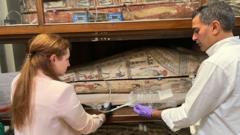
In a surprising revelation, scientists have found that ancient Egyptian mummies, despite being entombed for over 5,000 years, still carry an appealing fragrance. A study involving nine mummies showcased a range of aromas described as "woody," "spicy," and "sweet," sparking curiosity about the ancient embalming methods used during the mummification process. Researcher Cecilia Bembibre expressed a desire to recreate and share these scents, aiming to evoke a sensory experience for visitors at the Egyptian Museum in Cairo.During the mummification process, the ancient Egyptians employed various scented oils, balms, and waxes to prepare the deceased for their spiritual journey into the afterlife. Contrary to popular depictions in movies and literature where mummies are associated with foul odors, Bembibre noted the unexpected pleasantness of the mummies' scents.The study, published in the Journal of the American Chemical Society, utilized a non-invasive technique to collect scent samples from inside the sarcophagi through a tiny tube, preserving the mummies' integrity while allowing the researchers to analyze the scents. This method exemplifies the heritage scientists' continuous efforts to obtain insights without causing harm.Ally Louks, a literature expert from the University of Cambridge, praised the innovative approach of incorporating scents to convey historical experiences. She emphasized the importance of smell in ancient Egyptian culture—essential to their social, religious, and personal practices.Along with providing a new sensory dimension for museum visitors, the findings could signify advancements in mummy conservation. Researchers applied gas chromatography to distinguish the various odors, uncovering the breakdown of embalming fats, which may indicate the state of decomposition. This knowledge will facilitate better preservation strategies, ensuring that these remnants of history can be appreciated by future generations. Overall, the discovery not only brings a fresh perspective to ancient Egyptian culture but also holds the potential to transform how we engage with history through the senses, melding past and future.