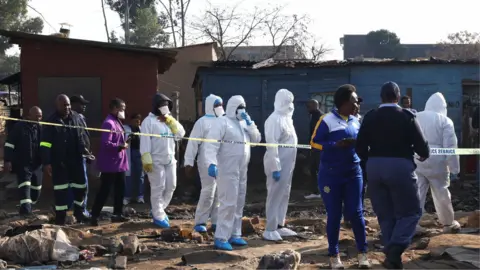
Johannesburg’s Jumpers Informal Settlement suffered a mass shooting that claimed 12 lives and injured nine others, setting the city’s unofficial settlement residents and the wider Johannesburg community adrift.
At roughly 23:10 local time (21:10 GMT), police responded to a reported attack. They revealed that at least ten suspects, wielding rifles, entered the settlement, opened fire on residents, and escaped in a white Toyota Quantum.
The authorities are mounting a manhunt, yet no arrests have been made. Evidence suggests the motive could be linked to a turf war surrounding illegal gold mining in the area.
Illegal mining, a lucrative but environmentally destructive activity, has seasoned Johannesburg’s suburbs with frequent violence. The mining operation can strip soil, contaminate water runoff, and destabilize soils, amplifying already fragile climate linkages. When communities face crime and resource conflicts, communal capacity to mobilise for climate‑friendly practices—such as community gardens, local green infrastructure, or renewable energy projects—dwells in jeopardy.
The shooting’s brutality has rippled beyond the immediate loss of life. Districts like Cleveland, while striving to rebuild after this tragedy, must simultaneously address an influx of refugees, driftwood, and the mental toll of living under armed threats. The resultant instability hampers civic participation in environmental initiatives and could sideline efforts to integrate climate adaptation measures into community planning.
In a broader context, South Africa’s 3 million legally registered firearms, matched by an equivalent number of unlicensed arms, pose an ongoing risk to communal and environmental safety. The sectoral challenge demonstrates that without robust gun control and systemic protection against illegal resource extraction, progress toward a resilient, climate‑aware future stalls.
Given the seriousness of the incident, the provincial police commissioner, Lt Gen Tommy Mthombeni, highlighted the area’s proximity to illegal mining zones, noting that “this may be tied to ongoing conflict over mining rights.” By framing the tragedy as a “heartless and barbaric” attack, authorities underline its potential ripple effect on local climate resilience strategies and the urgency for a holistic response.
International observers and domestic policy makers are re‑examining the overlap between illegal mining, community devastation, and climate action. Recent interventions—including the deployment of military forces to curb gold mining operations—signal a shift toward protecting both human lives and ecosystems.
For now, the search for perpetrators continues. The hope remains that swift justice and community rebuilding will pave the way for renewed engagement in sustainable futures, offering the affected residents a chance to reclaim not only their lives, but also their environmental stewardship.