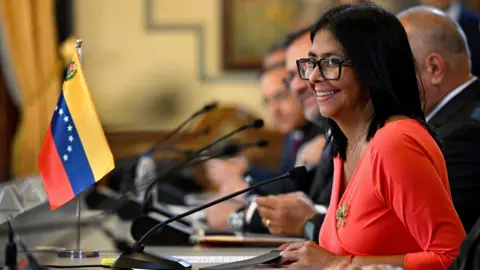
Human rights groups in Venezuela have criticized interim President Delcy Rodríguez for stating that a scheme to release political prisoners was 'coming to an end', having been in place for just nine weeks.
Nearly 500 political prisoners have been released under the amnesty law brought in by the country's National Assembly, prisoner rights group Foro Penal reports, but many more are believed to remain incarcerated.
The group stressed that Rodríguez lacked the authority to end the releases, while watchdog Provea condemned the move as 'arbitrary and unconstitutional.'
Despite her close ties to former President Nicolás Maduro, Rodríguez has garnered support from Donald Trump since U.S. forces removed Maduro from power in January.
Trump's unexpected endorsement of Rodríguez over opposition leader María Corina Machado, along with the release of various political prisoners — including some of Machado's colleagues — indicated a pivotal concession to the U.S. by the interim administration.
The president of the National Assembly, Jorge Rodríguez (Delcy's brother), initially announced that 1,557 political prisoners had applied for amnesty, which was expected to eventually cover 11,000 individuals.
According to Foro Penal, as of April 20, 473 individuals classified as political prisoners had been released, while more than 500 are suspected to still be detained.
In a recent meeting of justice officials in Caracas, Delcy Rodríguez claimed that 8,616 people had been released under the amnesty law, which she regarded as 'very successful in terms of its scope and the number of beneficiaries'.
She mentioned that those cases not covered by the law could be addressed through alternative routes.
Foro Penal's vice-president Gonzalo Himiob stated that only another legislative act or a referendum could overturn the amnesty law, which holds no expiration date.
He remarked, 'The bodies of the administration of justice, which are part of the same repressive system that made an amnesty necessary, never truly had either the willingness or the capacity to apply the amnesty law while respecting its purpose or principles.'
His sentiments echoed those of Provea, which stated that ending the release of political prisoners 'does not contribute to the process of co-existence and peace that has been announced.'
They asserted, 'Despite its limitations, the Amnesty Law is a first step toward dismantling the repressive framework that has gripped the rights of the Venezuelan population in recent years.'
Meanwhile, the Justice, Encounter and Pardon group labeled the announcement a 'grave assault on the rule of law.'
They lamented, 'This outcome confirms our initial concern: the law ended up being an exercise in political rhetoric rather than a genuine instrument to restore freedom to political prisoners.'
Maduro's administration has historically used the detention of political prisoners to suppress dissent and silence critics.
Rodríguez, previously Maduro's vice-president, aims to portray her interim administration as more tolerant of political dissent while seeking to strengthen ties with the U.S.
Earlier this month, Washington lifted sanctions on her, citing progress toward 'promoting stability, supporting economic recovery, and advancing political reconciliation.'
Trump's decision to prioritize Rodríguez over Machado has been viewed by analysts as opting for stability over democratic values in the short term.
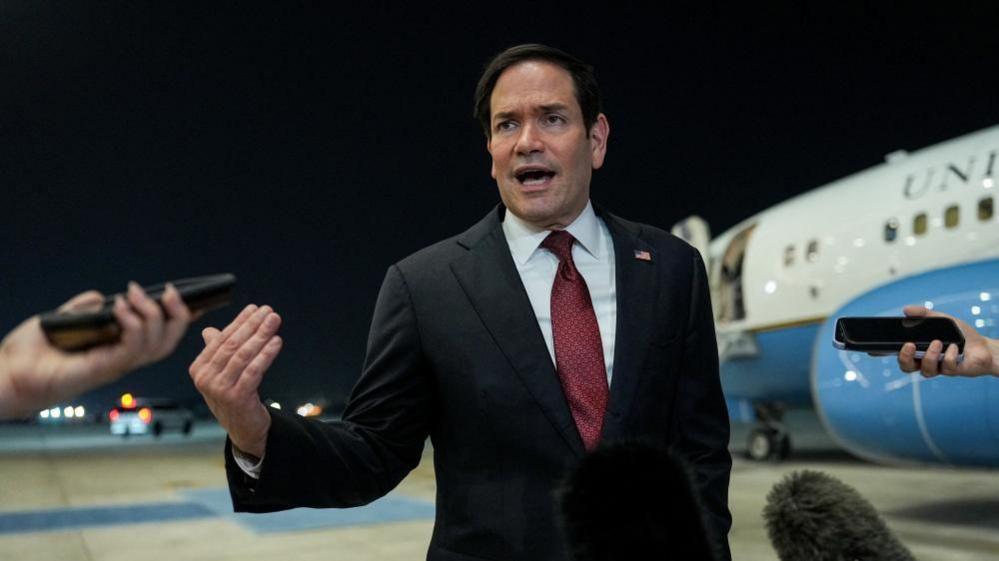
Recently, U.S. Secretary of State Marco Rubio described the situation in Venezuela as a 'transition phase' leading up to 'free and fair' elections.
Machado has said that she will take the lead in the country 'when the right time comes.'
However, critics of the interim administration have expressed concerns regarding a lack of discussion about democratic elections in the months following Maduro's removal and subsequent transfer to New York for drug trafficking charges.